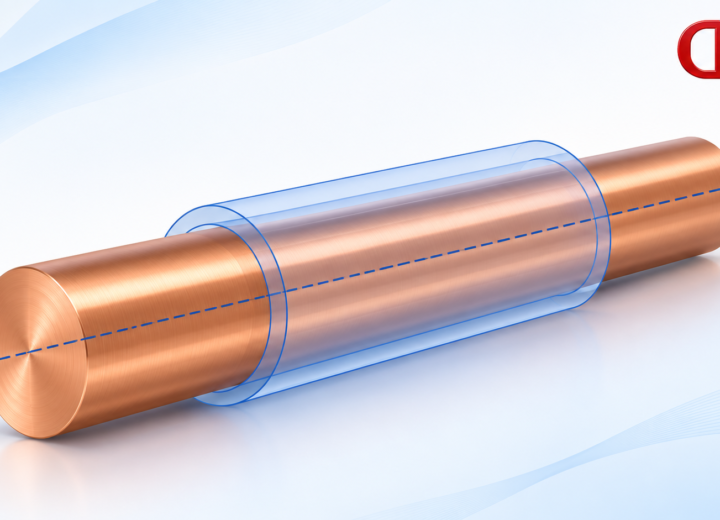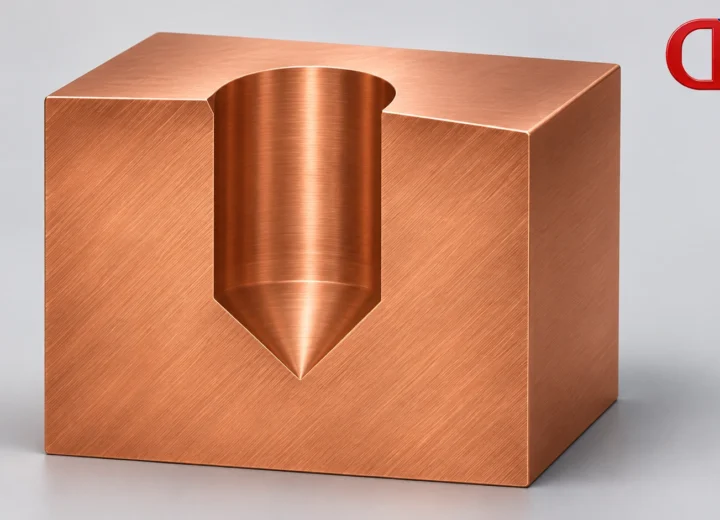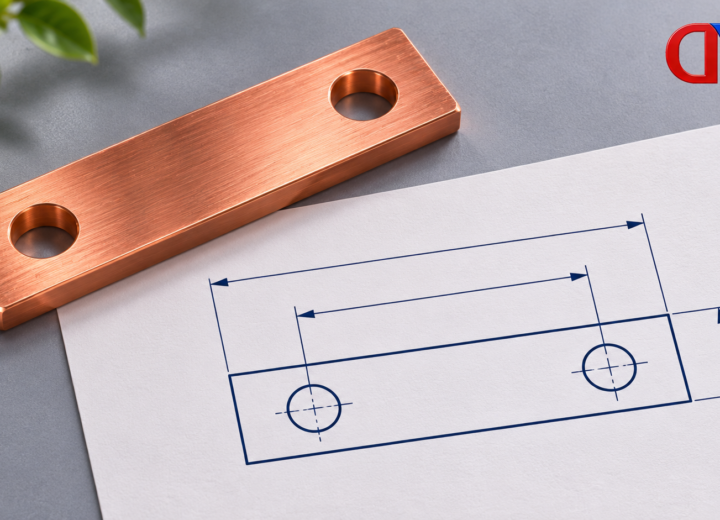

The specific heat capacity of copper metal is 0.385 J/(g·K), or 385 J/(kg·K), in the University of Texas table at 25°C and 1 atm. The same table gives a molar heat capacity of 24.47 J/(mol·K). Keep the reference conditions and amount basis with the number before using it in a calculation.
A mass-specific value describes the heat associated with a temperature increase per unit mass. A whole copper component has a heat capacity that also depends on how much copper it contains. Neither quantity is the same as thermal conductivity, which concerns heat flow through a material.
Specific heat capacity of copper metal: check the amount basis
Grams, kilograms and moles belong to different calculation inputs. The following entries distinguish the lookup value from the capacity of a complete part.
| Quantity | Value or relation | Amount basis |
|---|---|---|
| Mass-specific heat | 0.385 J/(g·K) = 385 J/(kg·K) | Per gram or kilogram; reference at 25°C, 1 atm |
| Molar heat capacity | 24.47 J/(mol·K) | Per mole; same table conditions |
| Whole-part heat capacity, C | C ≈ m × c | For the chosen mass and constant-c approximation; J/K |
Use a gram-based mass with the gram-based value, or a kilogram-based mass with the kilogram-based value. Multiplying kilograms by 0.385 J/(g·K) without converting the mass introduces a factor-of-1,000 error. The molar entry instead requires an amount in moles.
A unit-checked heat calculation for a copper block
For sensible heating without a phase change, a constant-specific-heat estimate is Q ≈ m × c × ΔT. Q is the heat transferred to raise the sample’s temperature, m is its mass, and ΔT is the final temperature minus the initial temperature.
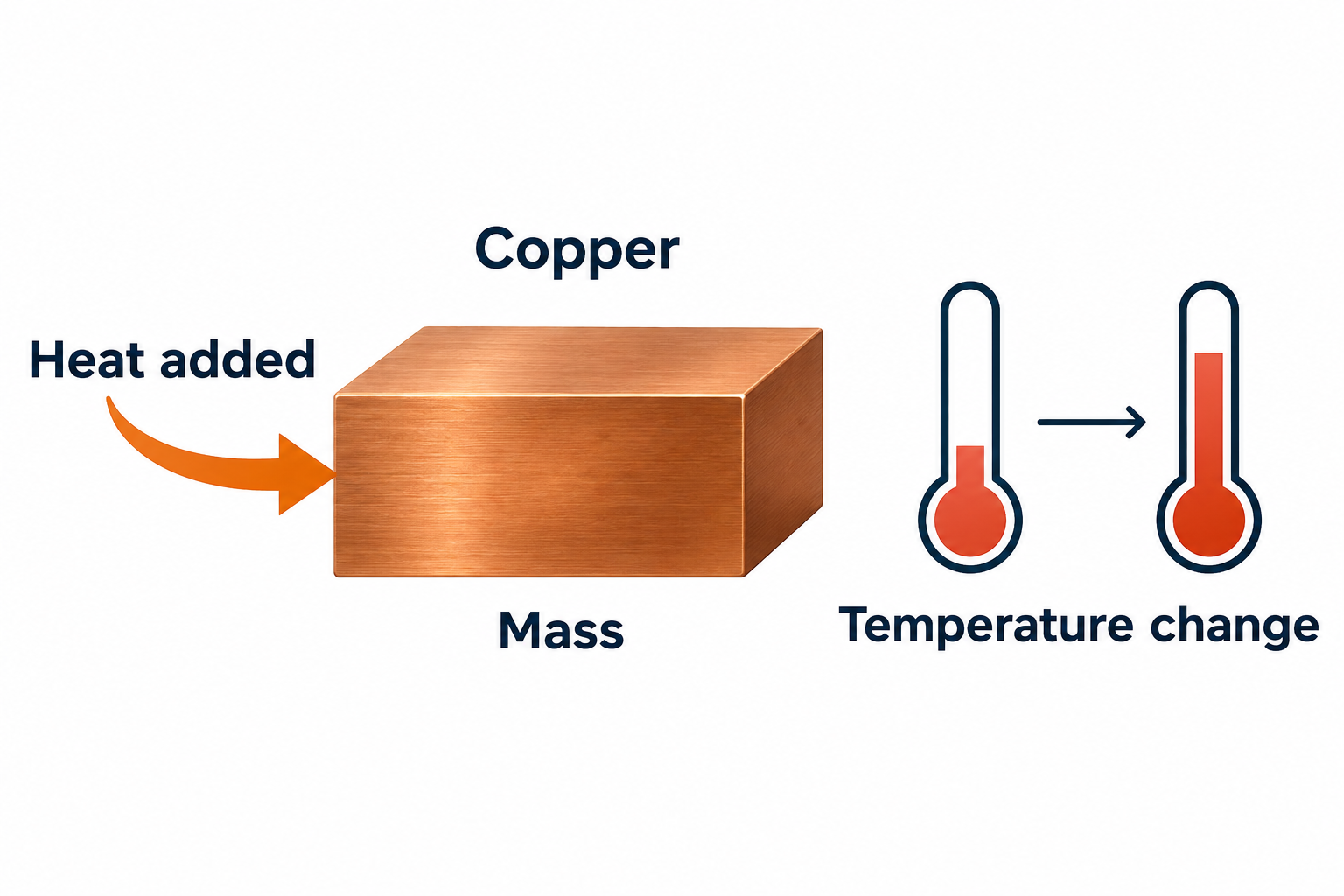
Take a hypothetical 0.500 kg copper block warming from 25°C to 35°C. Approximate c as 385 J/(kg·K) throughout that interval. The temperature increase is 10°C, equal to a change of 10 K.
Q ≈ 0.500 kg × 385 J/(kg·K) × 10 K = 1,925 J = 1.925 kJ.
The same arithmetic using grams gives 500 g × 0.385 J/(g·K) × 10 K = 1,925 J. This second route checks that the mass and specific-heat units agree. Under the same approximation, the block’s heat capacity is 0.500 × 385 = 192.5 J/K.
The result estimates the block’s sensible heat increase. It does not specify how much electrical energy a heater consumes or how long warming takes. Those are different questions that require information beyond the material’s specific heat.
When a single reference value is insufficient
Specific heat depends on temperature and phase. The NIST Chemistry WebBook provides a temperature-dependent expression for solid copper and separate liquid-phase data. A room-temperature value should therefore not be treated as a constant for every temperature interval or used alone to calculate melting energy.
For a broader interval, select appropriate temperature-dependent data or a justified average over that interval. Keep the source, phase and units together. The simple example above deliberately uses a constant reference value and reports an estimate.
For an enquiry about DONGYAO’s T2 copper blocks, state the material identification, component mass, initial temperature and target temperature. Also identify whether the question concerns stored heat, heat flow or heating time. The product listing provides material and dimensional context; it does not turn this generic reference value into a tested heat-capacity specification for a supplied batch.
References
- University of Texas: specific and molar heat capacities at 25°C and 1 atm.
- NIST Chemistry WebBook: copper condensed-phase thermochemistry.
- OpenStax College Physics 2e: temperature change and heat capacity.
For related conductor products, view the product categories.