Illustrative scenario: When a purchasing engineer in Manchester compared a US wire-scrap offer with a European plate quote, the per-pound number looked much lower. Converting both to the same weight unit removed the apparent bargain before any grade or machining differences were considered.
Summary: The September 2026 World Bank refined-copper average converts to about US$6.57/lb. One ordinary pound equals exactly 0.45359237 kg, so US$14.474/kg becomes approximately US$6.5653/lb before display rounding to cents. This is a historical refined-metal reference, not a current scrap, ingot or fabricated-part offer. Normalize units, identify the grade and payable weight, then compare delivered cost.
A scrap copper price can inform the raw-material side of finished-part sourcing, but it cannot establish the price of a cut plate or punched conductor. The relevant comparison is between offers with the same metal content, processing scope and commercial basis.
Convert pounds, kilograms and metric tonnes consistently
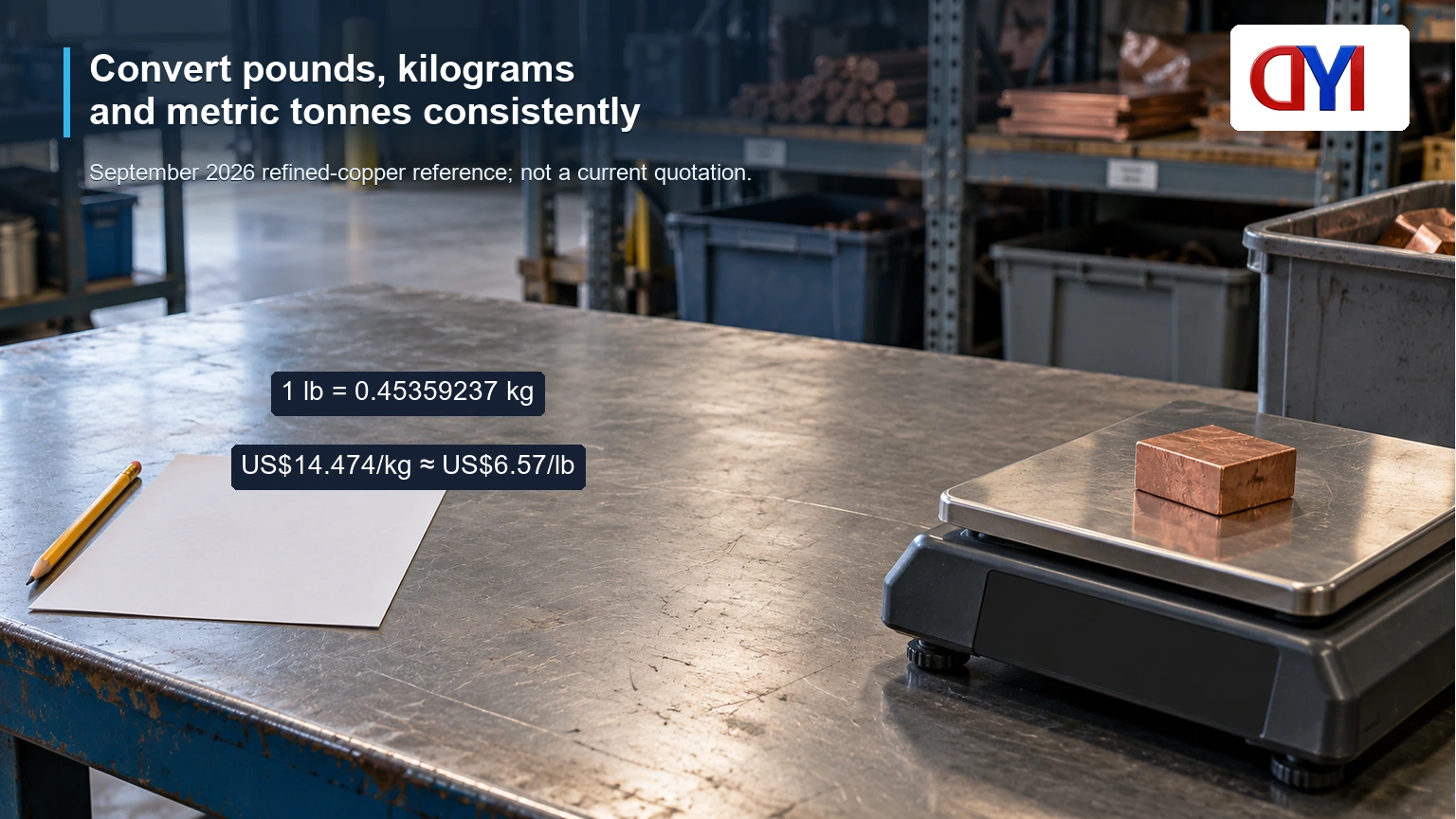
NIST’s SI conversion guidance gives 1 lb = 0.45359237 kg exactly. Multiply a US$/kg figure by 0.45359237 to obtain US$/lb; divide a US$/lb figure by that factor to obtain US$/kg. A metric tonne contains 1,000 kg, so the World Bank’s US$14,474/tonne becomes US$14.474/kg and approximately US$6.57/lb.
The World Bank defines this series as copper on the LME, standard Grade A, cathodes and wire bar shapes, physical settlement. It describes refined metal, not mixed scrap or an individual ingot, and is a September average, not an October 20 quotation.
Calculate from the unrounded US$14.474/kg figure. Record currency, date and net metal weight; packaging is not payable copper.
Identify which pound of material is being priced
The scrap copper price applies to a defined incoming material, not automatically to its full gross weight as pure copper. Insulation, attachments, moisture and other metals can change both recovery and processing requirements. A buyer needs the grade description, sampling basis and settlement deductions before comparing two numbers per pound.
For an explicitly hypothetical illustration, 1 lb of feed yielding 80% payable copper contains 0.8 lb of payable metal. At the historical refined reference, that is about US$5.25 of contained-metal reference value before recovery costs and commercial adjustments. It is not a scrap purchase offer or an assumed yield for any real shipment.
The International Copper Association explains that copper can be recycled repeatedly without losing performance. Properly produced recycled material can match primary material; variable incoming scrap creates the need for sorting, refining and verification. A recycled copper price therefore has no universal discount solely because the copper has been used before.
A finished-part price includes more than metal
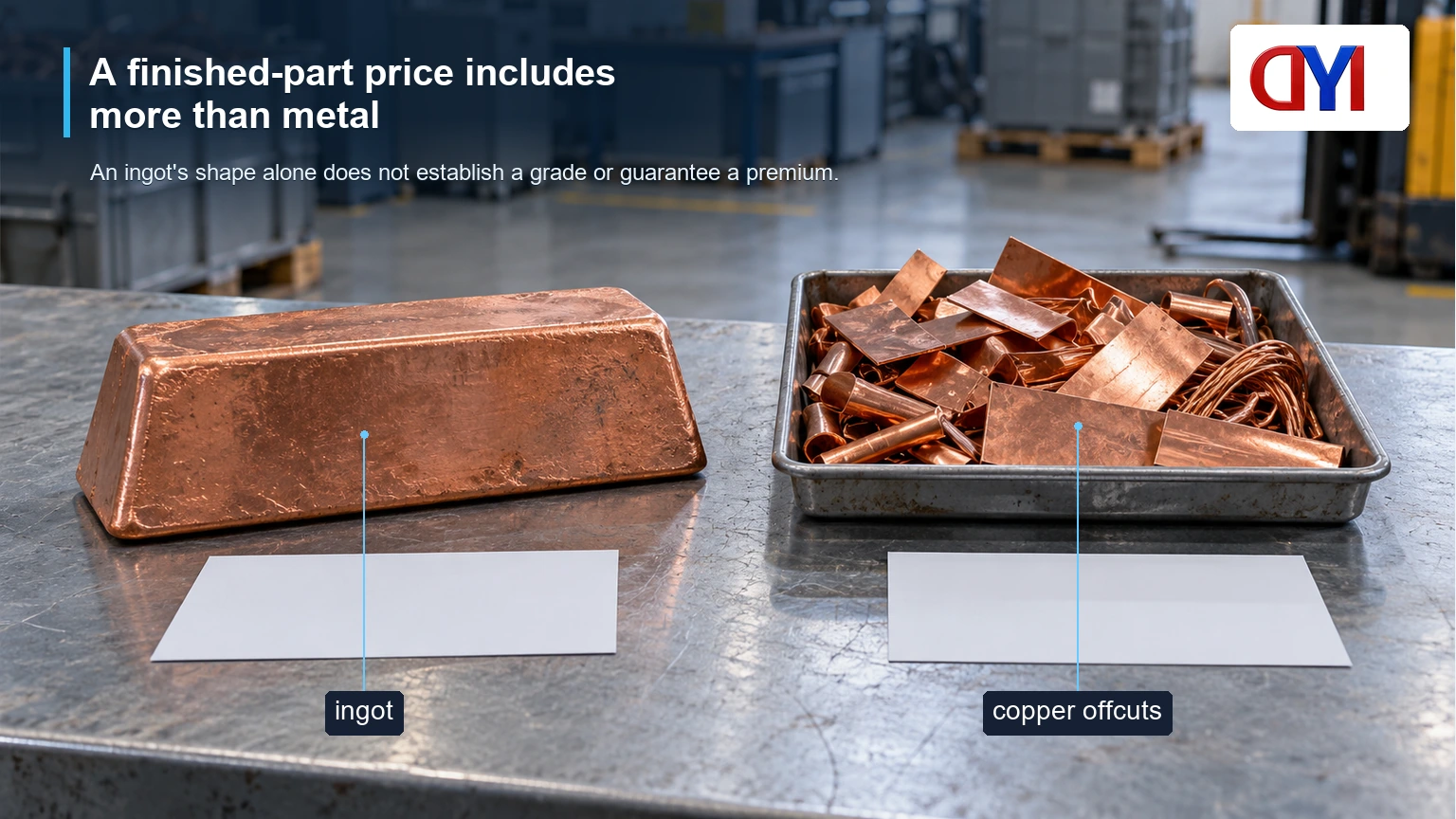
An ingot’s shape alone does not establish a grade or guarantee a premium. The copper ingot price depends on accepted chemistry, traceability, dimensions and the buyer’s intended process. Melting uncertain scrap into a compact shape does not remove its impurities or establish an accepted alloy designation.
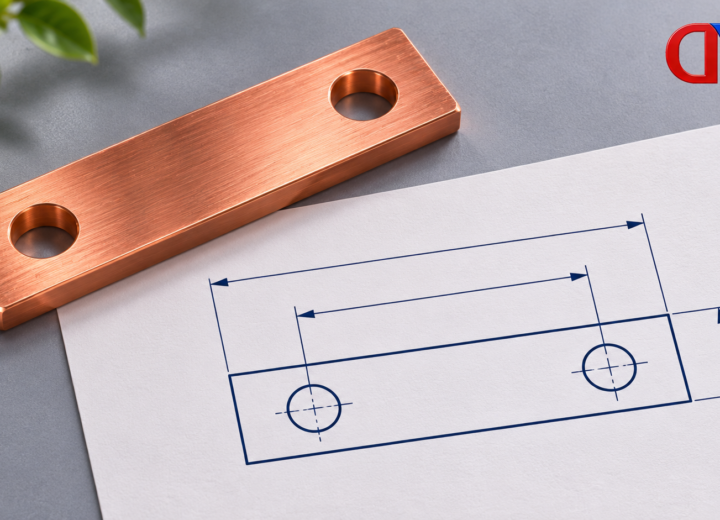
Finished components add a different commercial scope. A drawing for copper busbars may require cutting, bending, punching and surface treatment. The quoted pound of finished material can include those operations, inspection and packaging. A pound of unprocessed feed does not include that work.
The Copper Development Association lists ASTM B152/B152M for covered copper sheet, strip, plate and rolled bar, and ASTM B187/B187M for applicable busbar, rod and shape products in its C11000 alloy information. Match the specification to the supplied form, grade and condition, and confirm the required edition with the supplier. A material specification does not set fabrication prices or certify an entire electrical assembly.
Compare the same supplied form and accepted weight
A price per pound becomes useful only after the buyer knows which pound is being priced.
| Purchase category | Meaning of the quoted pound | What establishes usable value |
|---|---|---|
| Refined benchmark | Specified refined metal | A dated market reference; local delivery and fabrication remain separate. |
| Incoming scrap | Gross, sorted or payable weight, as agreed | Grade, recoverable content, deductions and buyer acceptance. |
| Refined recycled material | Accepted material of a specified grade | The recycled copper price reflects specification and terms, not a mandatory origin discount. |
| Ingot | Net mass of the accepted casting | Assay, contamination limits and suitability for the receiving process. |
| Fabricated part | Finished component mass | Specified material, drawing compliance, processing and inspection. |
Check the delivered cost drivers
For copper plates, compare cutting and documentation scope against the same drawing.
| Cost driver | Effect on the comparison | Quotation detail to obtain |
|---|---|---|
| Weight and recovery | Gross and payable pounds can differ. | Net weight, sampling and agreed deductions. |
| Grade and evidence | Unverified material can require extra qualification. | Designation, chemistry and required test records. |
| Geometry and processing | Cutting allowances and operations affect cost per finished pound. | Dimensions, tolerances, holes, bends and finish. |
| Order quantity | Setup charges are spread over the accepted lot. | Quantity, minimum order and separately stated setup charges. |
| Delivery and settlement | Taxes, freight and exchange terms alter delivered cost. | Currency, validity, tax basis, transport and payment terms. |
Match the material standard to the product form
The Copper Development Association lists ASTM B152/B152M for covered copper sheet, strip, plate and rolled bar, and ASTM B187/B187M for applicable busbar, rod and shape products in its C11000 alloy information. Match the specification to the supplied form, grade and condition, and confirm the required edition with the supplier. A material specification does not set fabrication prices or certify an entire electrical assembly.
The specification does not automatically apply to ingots or scrap. Citing it establishes neither factory certification nor electrical assembly approval. Specify product form, grade, condition and evidence; assess destination-market and end-use requirements separately. Unsupported grade equivalence can cause rejection despite correct delivered weight.
For an explicitly hypothetical quote of US$5.00/lb, divide by 0.45359237 to obtain about US$11.02/kg. Multiplying by the same factor in both directions is a common spreadsheet mistake. Keep the original unrounded number for calculation, round only the displayed result, and identify an avoirdupois pound rather than a troy unit. An ordinary US short ton is 2,000 lb; a metric tonne is 1,000 kg, so a price per ton needs its unit spelled out.
Use unit conversion as the start of supplier selection
- Define the purchase. Separate scrap recovery, remelting feed and finished-part requirements. For processed components, DONGYAO, Wenzhou Dongyao Trading Co., Ltd., supplies and custom processes copper busbars, rods, plates and blocks.
- Normalize the numbers. Use the same currency and weight unit. Record timestamps and use unrounded conversion inputs.
- Fix the acceptance basis. State grade, net or payable weight, dimensions and required records. For scrap, agree sampling and recovery settlement; for components, agree drawing and material requirements.
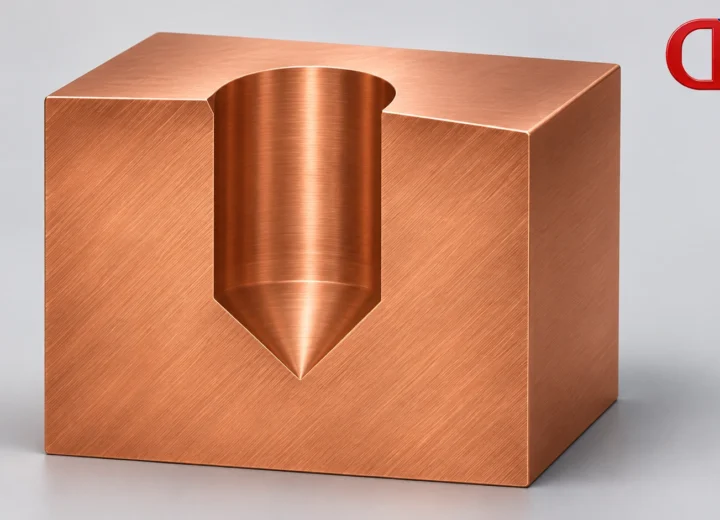
- Compare delivered usable cost. Include specified operations, inspection, packing and transport. A cut block is a finished-material purchase and should not be compared with a commodity ingot solely by shape.
Frequently asked questions
How much is a 1 kg copper ingot worth?
At the World Bank’s September 2026 refined-copper average, 1 kg of qualifying copper represents US$14.474 of historical contained-metal reference value. That is not an ingot sale quote. Actual value depends on assay, accepted purity, casting condition, quantity and commercial terms.
What is the price of a copper ingot?
There is no single copper ingot price independent of mass and specification. As a historical arithmetic reference, the September average corresponds to about US$6.57 per ordinary pound of refined copper. A seller’s offer can include or deduct amounts for quality, processing, premiums, shipping and buyer acceptance.
Are copper ingots worth more than scrap?
There is no automatic premium. Melting unknown scrap does not certify its grade, and an unverified casting may be less useful to a buyer than clearly identified scrap. Compare accepted metal content, recovery requirements and the receiving process.
What is the price of 1 kg scrap copper in China today?
No verified live China quotation is provided in this article, and there is no single national price covering every scrap grade. Obtain a current city-specific CNY/kg offer with a timestamp, grade or assay, tax treatment and transport basis. The historical US-dollar refined benchmark above is not a China scrap price.
References
- World Bank, October 2026 Commodity Price Data (Pink Sheet): September refined-copper average and series definition.
- NIST, Guide to the SI, Appendix B: pound-to-kilogram conversion.
- International Copper Association, Copper Recycling: recyclability and material performance.
- CDA C11000 alloy data and applicable product specifications: copper sheet, strip, plate and rolled bar specification.
- UK Weights and Measures Act 1985, Schedule 1: exact pound definition, 0.45359237 kg.
A reliable copper price starts with an agreed pound of accepted material. For finished-part sourcing, contact DONGYAO about custom copper blocks, and provide the required grade, dimensions, quantity and delivery destination for a scoped quotation.
For related conductor products, view the product categories.