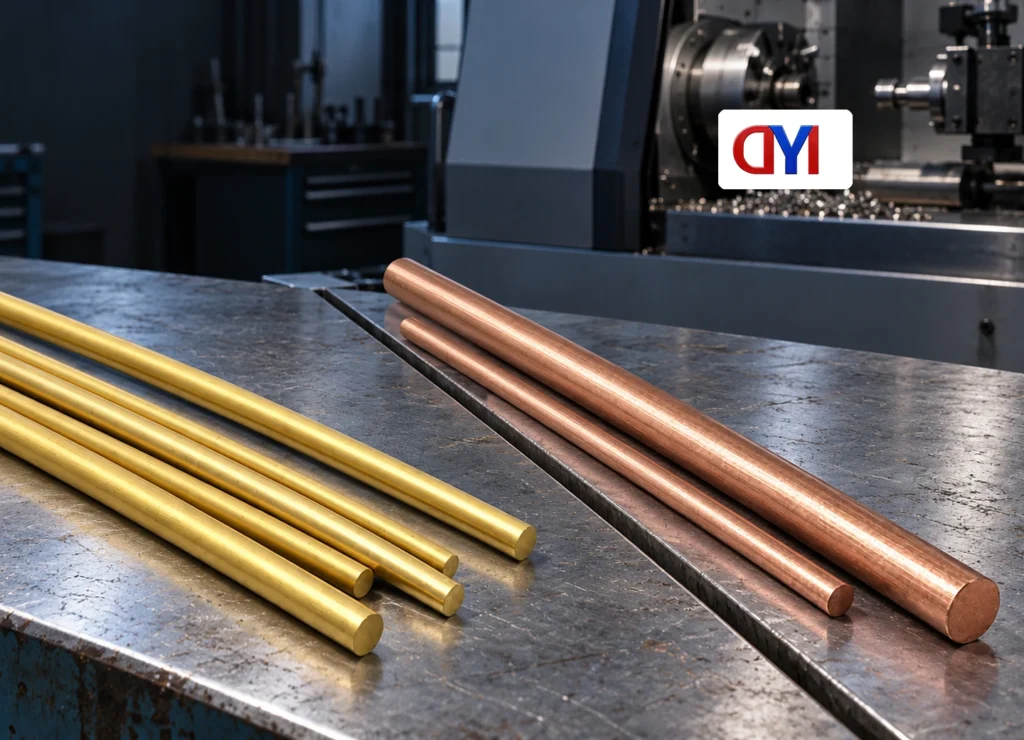
When a machining buyer in Derby, Marcus, encountered mixed rod blanks beside a production lathe, the similar sizes made them easy to confuse. In this illustrative scenario, brass and copper lots had lost their identities after cutting. The correction was to preserve traceability and approve the material before machining another component.
Summary: H59 brass rod and pure copper rod are different materials, not interchangeable precision blanks. Specify the governing grade standard, condition and minimum machining envelope. ASTM B16/B16M-24 identifies particular free-cutting brass grades; it does not create automatic equivalence with H59. Keep diameter and cut-length tolerances separate.
Start with the material designation
H59 is a brass designation used under an agreed material specification. Confirm the standard, edition, composition and supply condition rather than relying on a short trade label. Do not infer the exact composition limits from the digits alone or assume an equivalent international grade.
Pure copper and brass differ in composition and in the properties relevant to a component. A material that is convenient to cut may not satisfy the electrical or forming requirements of another drawing. The purchaser should state the approved grade and control any proposed substitution.
| Requirement | H59 brass rod | Custom copper rod | Buying decision |
|---|---|---|---|
| Material identity | Confirm the named brass specification | Confirm the recognized copper grade | Require lot-linked records |
| Machining behavior | Verify for the exact grade and condition | Verify for the exact grade and condition | Run the relevant process trial |
| Electrical use | Must meet the component design | Conductivity may be a key requirement | Do not substitute by appearance |
| Finished dimensions | Need diameter and length control | Need diameter and length control | Define minimum usable stock |
ASTM B16/B16M covers C36000/C36010 free-cutting brass products in its current scope. Calling H59 “ASTM B16 equivalent” without evidence can put an unapproved grade into production. ASTM B187/B187M provides a separate framework for specified copper bar and rod products.
Specify diameter and cut length independently
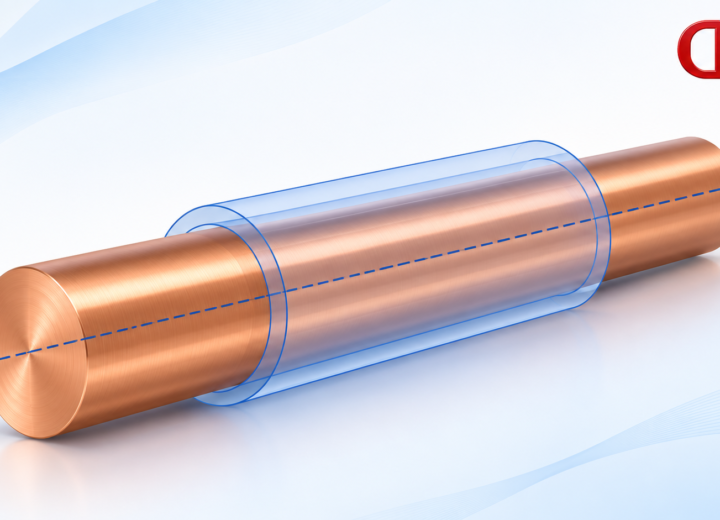
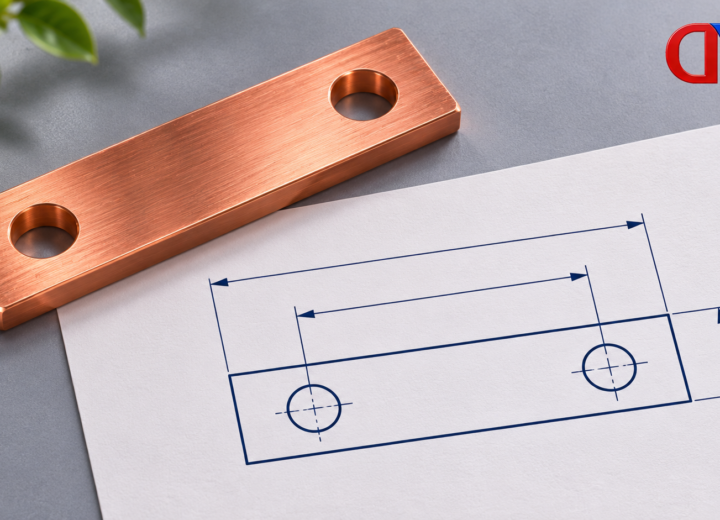
A precision-cut order needs more than the phrase “cut to size.” Define nominal diameter, diameter tolerance, cut length, length tolerance, end squareness and burr requirements. Identify which surfaces will be machined and which will remain as supplied.
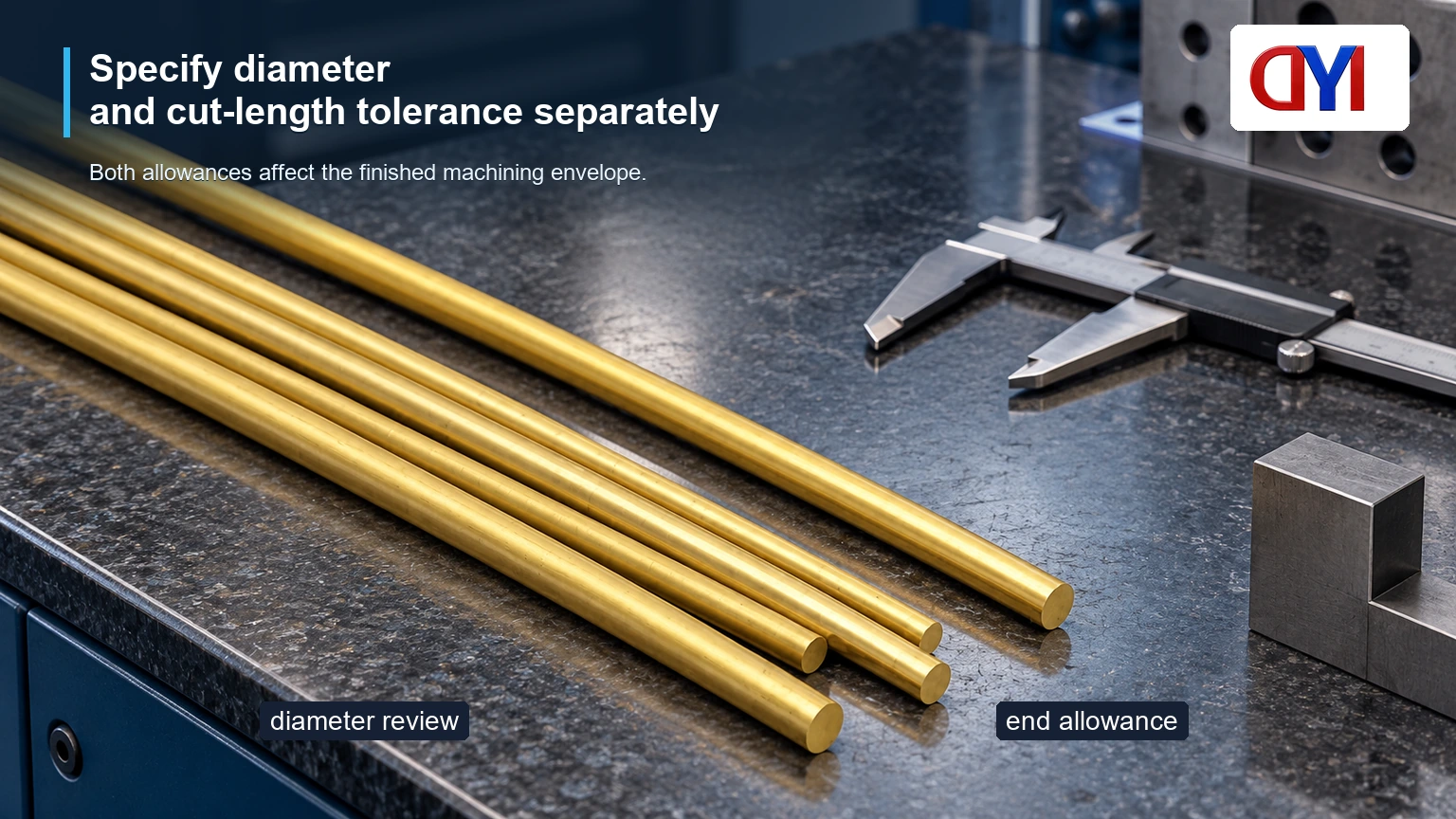
For an illustrative 30 mm finished length with 0.5 mm facing allowance at each end, the minimum usable blank length is 31 mm. If the supplier’s cutting tolerance allows a blank below 31 mm, the finished-part allowance is no longer assured. The required nominal order length therefore depends on the agreed tolerance, not just the arithmetic allowance.
Likewise, diameter allowance is radial. A planned 0.25 mm cleanup on each side adds 0.5 mm to the required finished diameter before stock tolerance. Confirm the measurement method and avoid using a length tolerance as if it also controls end squareness.
Allowance, yield and inspection cost
Excess stock creates machining time and chips; insufficient stock creates rejects. The practical optimum depends on the supplied condition, straightness, machine setup and finished geometry. Use a trial batch when these are uncertain.
| RFQ item | Required detail | Consequence if omitted |
|---|---|---|
| Grade and condition | Standard, edition and temper | Unapproved material may be quoted |
| Diameter | Nominal, tolerance and ovality requirement | Cleanup or feeding problems |
| Cut length | Length, tolerance and end allowance | Finished parts may be short |
| End and edge condition | Squareness, burrs and handling limits | Extra setup or damage |
| Records | Lot identity and inspection package | Mixed stock becomes difficult to trace |
A hypothetical 1,000-piece run with a 2% material-related rejection rate loses 20 pieces before rework and replacement costs. This is a planning example, not a claim about H59 or copper quality. Compare quotes on accepted output and agreed inspection, not an unsupported promise of “zero loss.”
Prevent material mix-ups after cutting
Separate brass and copper physically and keep their identifiers with each cut batch. A color difference can help an operator notice a problem, but it is not the formal identification method. Coatings, lighting and surface condition can make appearance misleading.
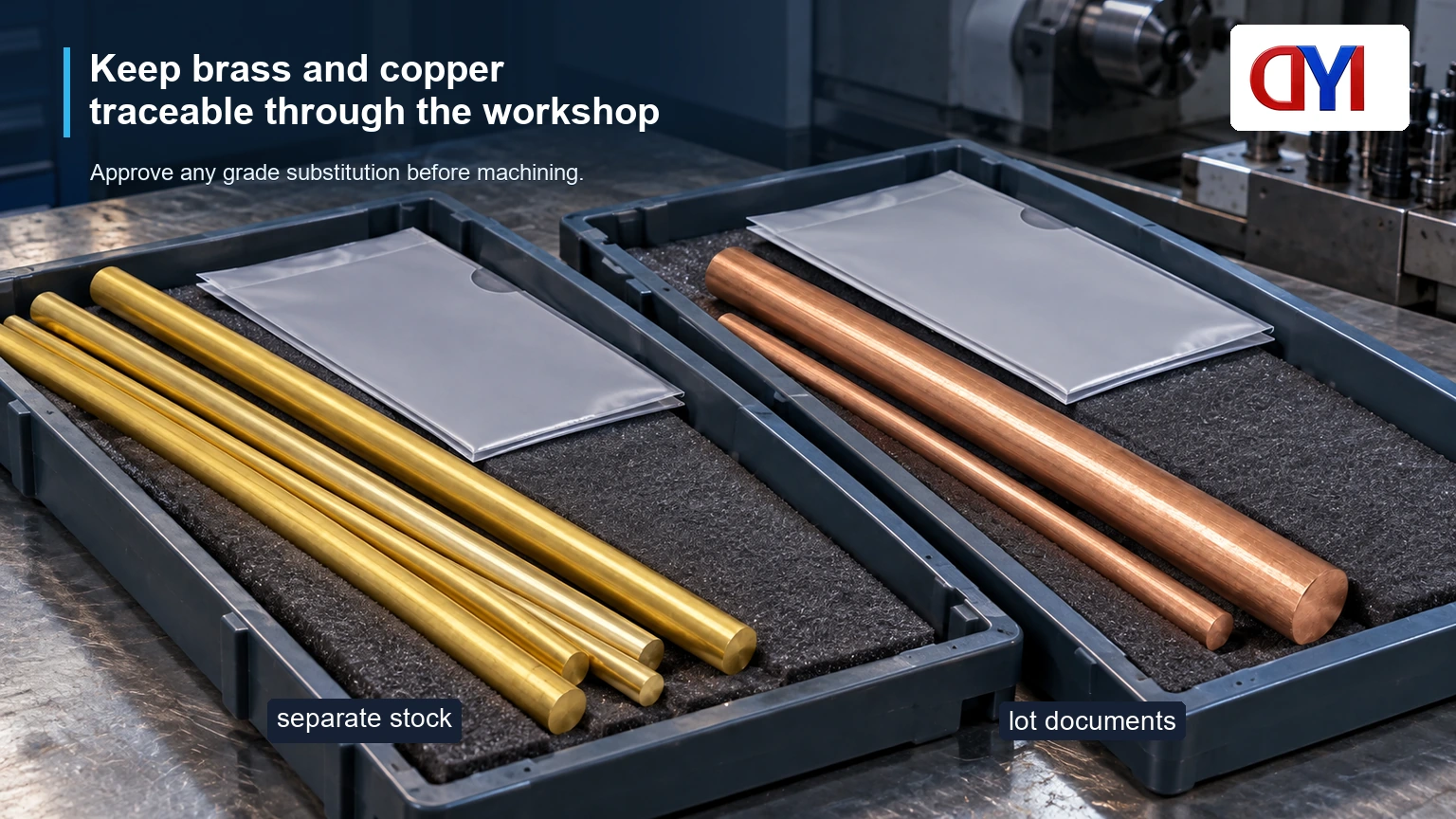
Use a receiving process that matches the purchase order, material report and delivered labels before stock enters the workshop. Maintain traceability when bundles are split. If an identity is lost, hold the material for approved verification rather than assigning a grade by guesswork.
If electrical resistivity is a specified property, ASTM B193 provides a relevant measurement method. A resistivity result still does not identify every compositional characteristic. Material, dimensional and functional acceptance should remain distinct in the inspection plan.
Standards and substitution approval
The applicable material standard is the one agreed for the specified grade and product. A general reference to “international standard brass” is not enough. Where the customer drawing restricts composition or substances, obtain the relevant material evidence rather than assuming a trade designation meets those requirements.
Approve four items before purchase: material identity; minimum machining envelope; inspection and traceability; and the procedure for proposed substitutions. DONGYAO’s brass rod stock and precision-cut copper rod listing can be reviewed against those requirements. Confirm H59 availability and conformity explicitly in the quote.
Frequently asked questions
What is H59 brass rod used for?
It is used as brass stock for components where that grade is approved by the design. The intended machining, forming and service requirements must be checked. A trade designation alone does not establish suitability for an electrical or regulated application.
How is H59 brass different from pure copper rod?
Brass is a copper alloy, whereas commercially pure copper is specified under different material designations. Composition affects relevant electrical and fabrication properties. Treat them as separate materials on the drawing and purchase order.
What should a precision-cut brass rod RFQ include?
Include grade and standard, condition, diameter, cut length and their tolerances. Add end squareness, burr requirements, quantity and records. State which dimensions describe the blank and which describe the finished part.
How do diameter tolerance and cut-length tolerance affect machining?
Diameter tolerance controls radial stock and feeding or clamping fit. Cut-length tolerance controls facing allowance and usable finished length. Each must be assessed against its own manufacturing requirement.
Should a brass grade be substituted without approval from the drawing owner?
No. Submit the proposed grade and supporting property or equivalence information for review. Similar names, colors or dimensions do not authorize substitution.
How can material mix-ups be prevented in mixed copper and brass orders?
Keep materials in separate identified locations and preserve lot labels after cutting. Match delivery records before release to production. Hold unidentified stock for verification rather than sorting it by color alone.
References
- ASTM B16/B16M-24: free-cutting brass grade scope
- ASTM B187/B187M: copper bar and rod requirements
- ASTM B193-25: resistivity of conductor materials
Precision starts with the right material in the right bin. Contact DONGYAO with the grade, drawing and cut-blank requirements for a traceable supply quotation.
For related conductor products, view the product categories.