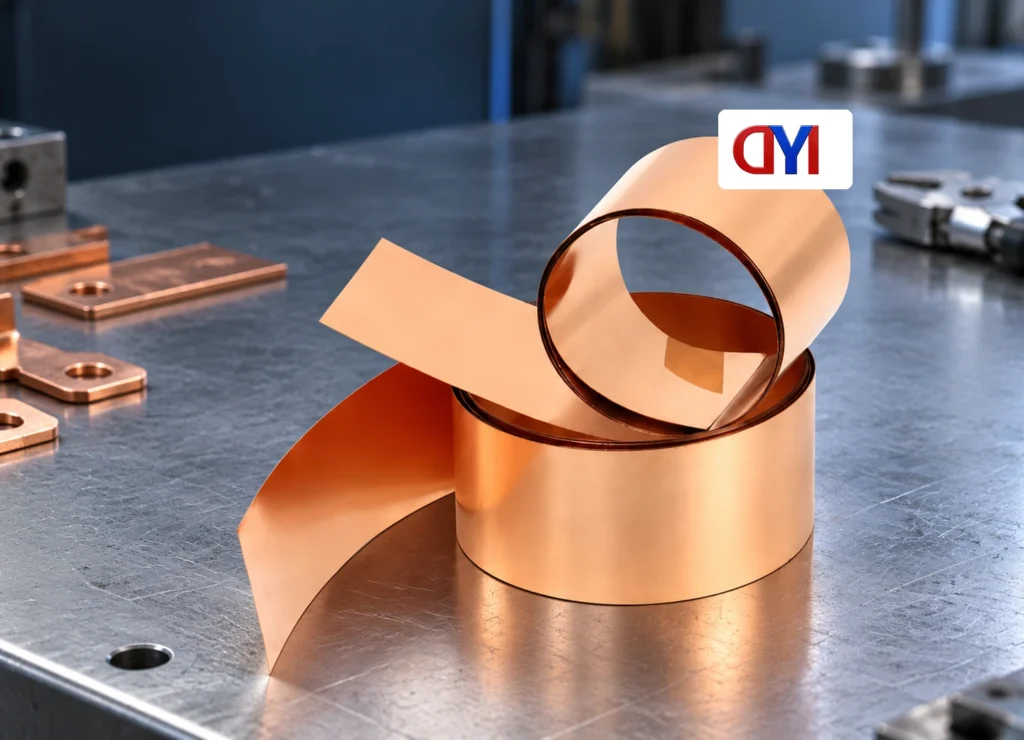
When a connector buyer in Nottingham, Grace, encountered cracks at the bend of a new copper strip part, the coil looked no different from the previous delivery. In this illustrative scenario, the supplied condition had changed while the order still said only “pure copper strip.” The solution was to control temper and the forming trial alongside dimensions.
Summary: Copper strip for connection parts needs a recognized grade, condition, thickness and width. ASTM B152/B152M covers several copper types and flat-product requirements; “pure” does not mean mathematically 100% copper. A nominal 0.5 × 20 mm strip has a 10 mm² section, but that geometry alone does not establish a current rating.
Convert commercial names into a material specification
Copper strip, purple copper strip and pure copper strip can describe overlapping commercial offerings. None is a complete grade designation. Specify the material standard, recognized grade and required condition before comparing suppliers.
ASTM B152/B152M identifies different copper types, including C10100 oxygen-free electronic copper and C11000 electrolytic tough-pitch copper. The specification also distinguishes its covered forms from certain other flat products. Confirm the appropriate product specification for the supplied edges, process and dimensions rather than assuming all flat copper is covered identically.
Composition and conductivity are related but different acceptance questions. ASTM B193 addresses resistivity measurement for conductor materials. A composition report does not automatically verify a finished part’s resistance, and neither proves an assembled joint’s thermal performance.
| Order description | What it establishes | Missing information |
|---|---|---|
| Pure copper strip | Broad material category | Grade, composition limits and condition |
| Soft strip | A commercial condition description | Recognized temper and mechanical requirements |
| Hard strip | A different condition description | Recognized temper and forming suitability |
| Slit strip | A processing form | Width tolerance, camber and burr limits |
Temper governs the forming plan
Soft and hard copper strip can respond differently to bending and handling. The appropriate condition depends on the part geometry and fabrication process. A soft strip is not automatically the best spring or load-bearing component, and a harder strip is not automatically suitable for a tight bend.
Specify the bend geometry and the direction relative to the supplied stock where relevant. Use a representative trial with the actual grade, condition and thickness. Avoid a universal bend-radius multiplier unless it is supported by the applicable specification and process evidence.
If a part is plated before forming, the coating’s behavior becomes another requirement. Agree on whether forming precedes or follows coating and how the completed surface is inspected. A material certificate for the uncoated strip does not approve that process sequence.
Control width, thickness and edge condition together
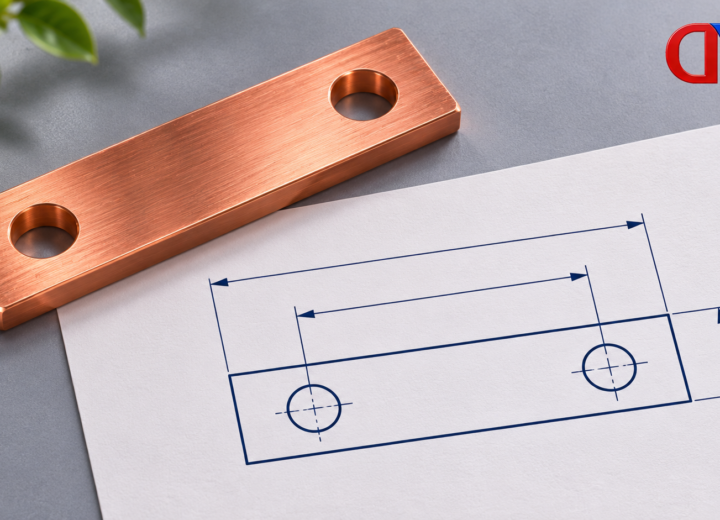
For a uniform rectangular strip, nominal area equals width multiplied by thickness. An illustrative 0.5 × 20 mm section has an area of 10 mm². Reducing thickness to 0.45 mm at the same width reduces nominal area to 9 mm², a 10% change. These are geometry calculations, not permitted tolerances or electrical ratings.
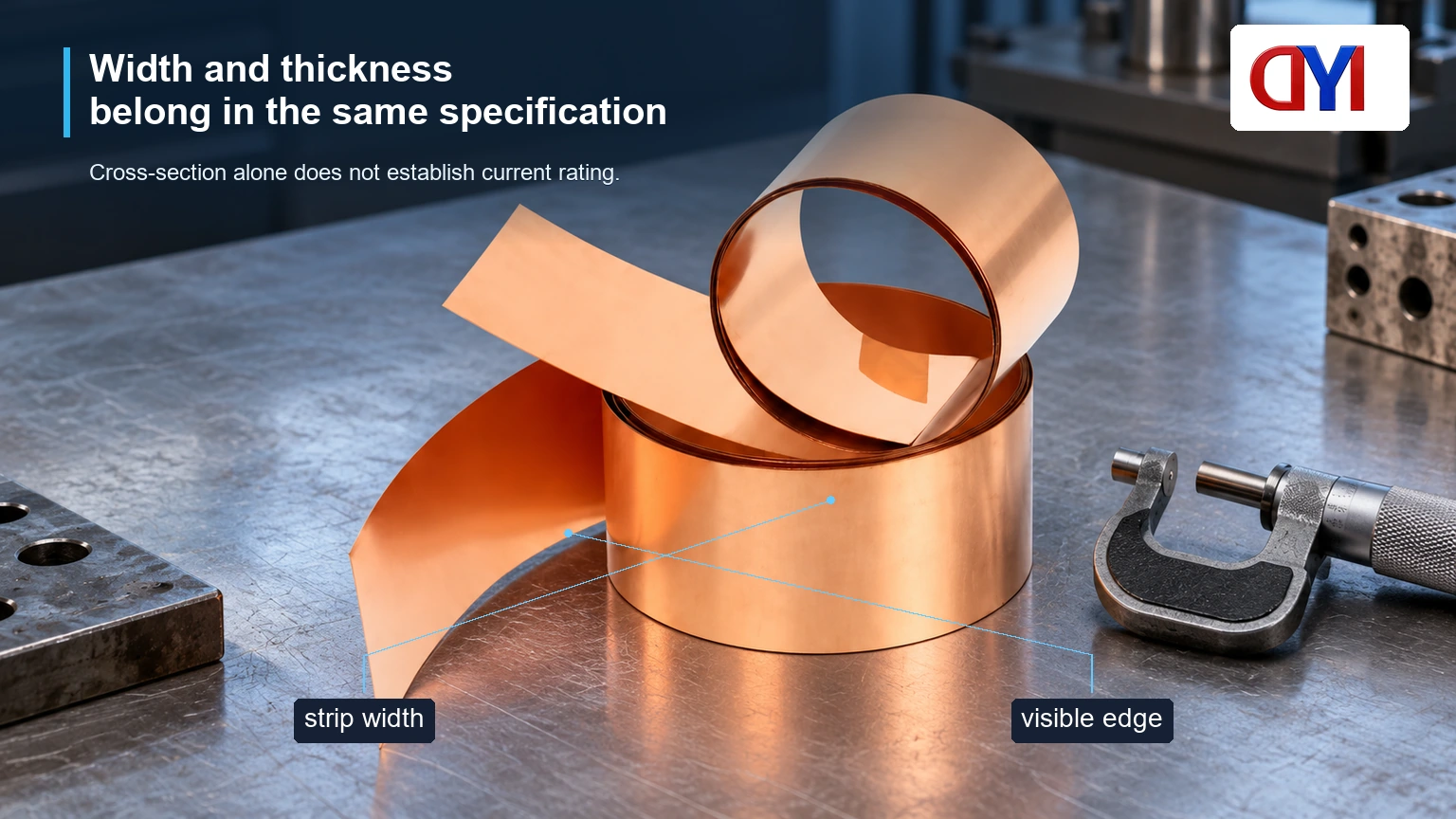
The dimensions should be measured using an agreed method and sampling plan. Include camber, edge condition and any required surface limits. A strip may satisfy width while having an edge burr that damages insulation or prevents consistent stacking.
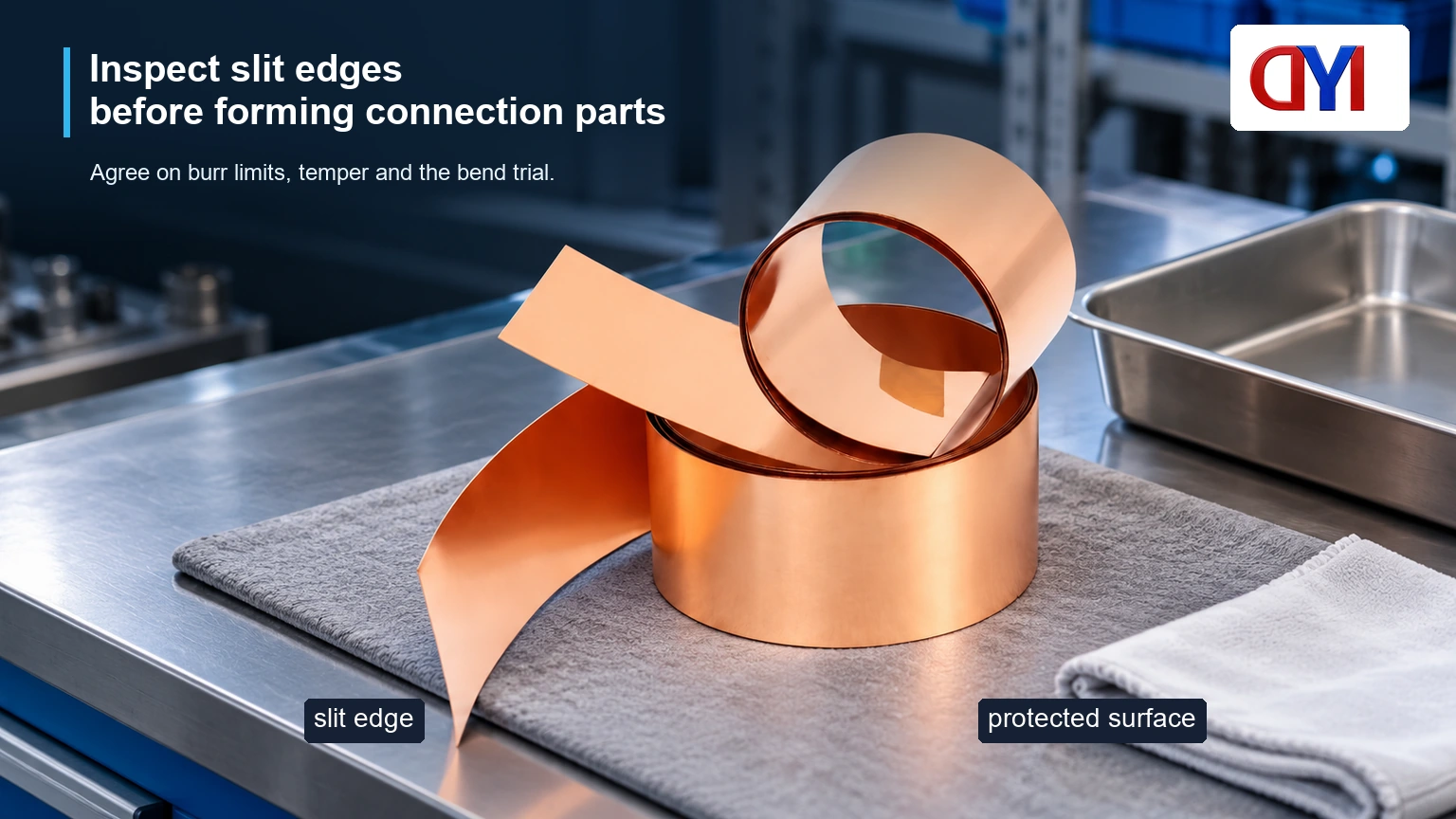
| Characteristic | Specify | Effect on the part |
|---|---|---|
| Thickness | Nominal and tolerance | Section, forming and stack height |
| Width | Nominal and tolerance | Fit, contact envelope and material yield |
| Temper | Recognized condition and requirements | Forming response and handling |
| Slit edge | Burr, edge contour and camber limits | Assembly, stacking and insulation clearance |
| Surface | Permitted defects and contact-area treatment | Subsequent processing and connection quality |
Compare cost per accepted connection part
Material mass, slit width, coil handling, tooling and reject rate all affect cost. State whether the quote includes slitting, cutting, forming or only raw coil. Confirm minimum quantities and usable coil length without assuming that all material on a roll is equally usable.
For a hypothetical strip layout, two 20 mm blanks require at least 40 mm of usable width before any process allowance. If the process needs edge trimming, a 40 mm supplied width cannot provide that allowance. The exact yield must follow the chosen cutting method and actual tolerances.
The connection itself also needs validation. OSHA 29 CFR 1910.303 addresses suitable electrical equipment and connections. A low-resistivity strip does not compensate for an unsuitable termination, damaged contact face or unapproved joint arrangement.
Procurement and standards checks
- Define the connection part and the applicable equipment requirements.
- Specify grade, temper, thickness, width and edge condition.
- Agree on forming, coating and contact-area requirements.
- Retain material and dimensional records and qualify the finished construction.
DONGYAO’s copper strip and foil supply form and copper connector products can be reviewed against a controlled drawing. Confirm the exact product thickness range and condition offered. A catalog name or standard reference is not a certificate for the delivered lot.
Frequently asked questions
What is a copper strip used for?
It can be used for electrical connection parts, formed components and other specified applications. Grade, condition and geometry determine suitability. The finished connection needs its own design and verification.
Can copper be 100% pure?
Commercial material is specified using finite composition limits and test methods. An absolute 100% claim is not a useful procurement specification. Request the recognized grade and applicable minimum copper content or impurity limits.
How much does a strip of copper cost?
Cost depends on grade, dimensions, condition, quantity and processing. Ask for a dated quote with a clear mass, length or piece basis. Include slitting yield, forming and inspection when comparing alternatives.
How do copper strip thickness and width affect electrical part design?
Together they determine nominal cross-sectional area and influence fit and heat dissipation. Actual current capacity also depends on the assembly, cooling, joints and service conditions. Do not assign a rating from area alone.
How does soft copper strip differ from hard copper strip?
They describe different mechanical conditions with different forming and handling behavior. Use a recognized temper designation and the relevant requirements. Confirm the selected condition through the actual fabrication process.
What material certification should a buyer request for pure copper strip?
Request lot-linked material identity and the test records required by the agreed specification. Add dimensional and conductivity evidence where specified. Avoid an undefined request for a generic “purity certificate.”
References
- ASTM B152/B152M: copper sheet, strip and related products
- ASTM B193-25: conductor resistivity measurement
- 29 CFR 1910.303: electrical equipment and connections
Control the material condition as carefully as the strip dimensions. Contact DONGYAO with the connection drawing, forming requirements and quantity for a documented supply review.
For related conductor products, view the product categories.