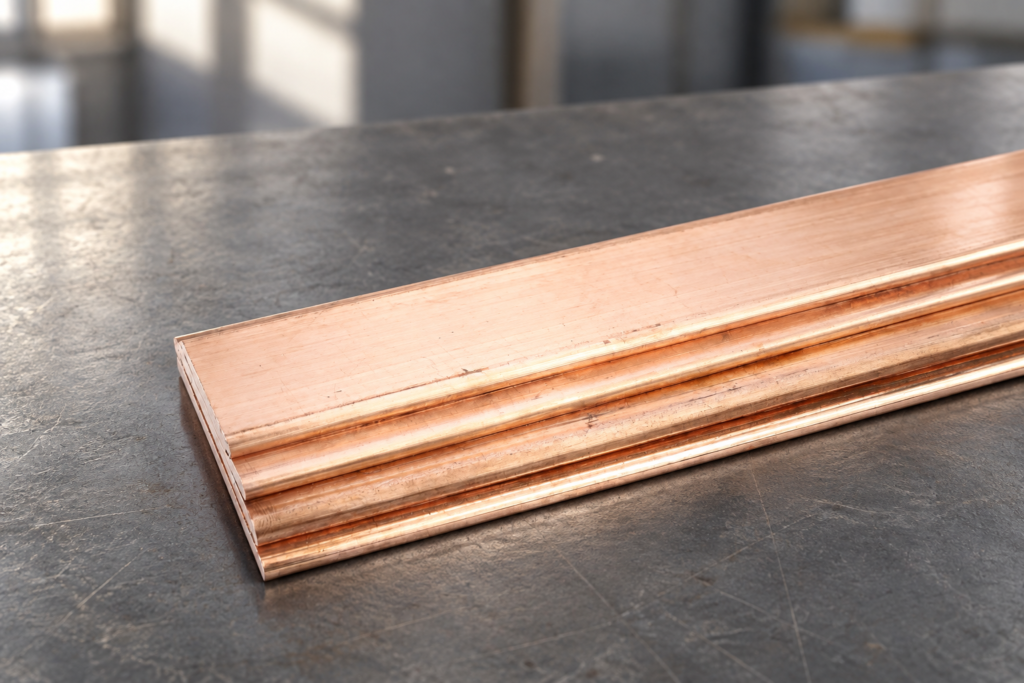
When a cable-recycling supervisor in Ningbo, Ms. Lin, changed a night shift from rotary knives to a narrow copper strip guide, the first coil looked like a success—until insulation tears appeared within minutes and the line jammed at the take-up. The visible failure was blamed on the blade, but a review found the real cause: strip width, edge radius, and feed tension had never been specified together. A controlled copper-strip profile, measured tooling, and a repeatable inspection plan restored yield on the next run.
Copper strips determine how cleanly a copper cable can be opened
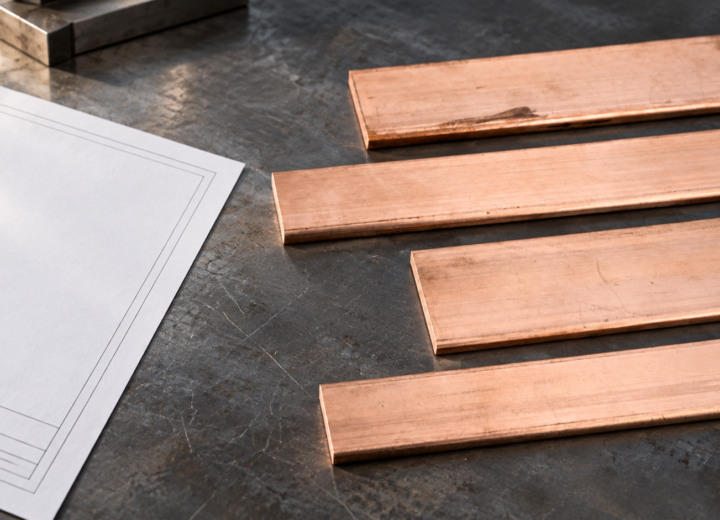
In a stripping machine, the strip is not merely a piece of metal; it is a controlled interface between blade, insulation, and conductor. The strip’s thickness controls how the guide holds its position, while width and edge geometry influence lateral stability as the cable bends. Copper remains highly conductive—NIST’s SI guidance defines the ampere and related electrical quantities—but conductivity alone does not guarantee a clean strip. Temper, residual stress, and burr height can change how the material tracks through a die. Buyers should treat the approved Copper strip sample as a process reference, not just a catalog item.
For procurement, separate three dimensions that are often merged in informal requests: nominal size, allowable tolerance, and functional result. A 0.50 mm strip with a ±0.02 mm thickness tolerance may behave differently from a nominally identical strip with ±0.05 mm variation when the knife clearance is only a few hundredths of a millimeter. Specify the measurement datum, sampling frequency, and acceptance limit; otherwise a supplier and a user can both be “within size” while producing different outcomes.
Stripping copper cable requires a process window, not a single dimension
A reliable process balances blade depth, feed speed, bend radius, and strip guidance. Begin with a short trial at low speed, then increase speed in measured steps while recording insulation tear rate and conductor nicks. A useful acceptance plan may inspect 10 pieces at start-up, 5 pieces every 30 minutes, and a final sample after a coil change; the exact frequency should reflect risk and customer requirements rather than habit. Document these settings whenever stripping copper cable so a qualified operator can reproduce the approved result.
Edge and surface control protect the conductor.
Edges should be free of loose burrs, roll marks, and embedded particles that can score insulation or abrade a conductor. Visual inspection under 10× magnification is a practical screen; where electrical performance matters, use four-wire resistance measurement and record temperature because copper resistance changes by roughly 0.39% per °C near room temperature. A simple go/no-go radius gauge can keep edge rounding consistent without pretending that a gauge replaces a functional strip trial.
Setup data turns operator skill into repeatable output
Record knife angle, overlap, cable outside diameter, insulation type, line speed, and tension in a setup sheet. If cable lots vary, set a changeover trigger—for example, a 0.3 mm increase in outside diameter or a visible change in jacket hardness. This data also exposes hidden costs: ten minutes of adjustment per coil can outweigh a modest material-price difference over a month of production.
A copper strip comparison should include quality risk and total cost
The table below compares common sourcing approaches. It is a decision aid, not a price list; actual cost depends on alloy, temper, dimensions, order quantity, packaging, and inspection scope.
| Approach | Performance tendency | Efficiency and setup | Durability and maintenance | Compatibility and returns | TCO implication |
|---|---|---|---|---|---|
| Commodity strip, broad tolerance | Variable tracking; more trial cuts | Fast to source, slower to tune | Edge variation can accelerate tool wear | Higher mismatch risk across machines | Low unit-cost tendency, potentially high downtime |
| Controlled strip, stated tolerance | Stable feed and cleaner separation | Setup values transfer between coils | Predictable wear and inspection intervals | Better fit when drawing and sample are shared | Balanced material and labor cost |
| Application-specific strip kit | Profile matched to cable and tooling | Shortest commissioning when data is sound | Documentation supports preventive maintenance | Best for qualified, repeat programs | Higher upfront engineering, lower process risk |
When a line handles mixed cable constructions, the second and third approaches often reduce rework because the team can trace a result to a defined lot and setup. Keep a retained sample from each approved batch so a later dispute can be resolved with evidence instead of memory. Consistent identification of copper strips also prevents an urgent substitution from entering the line unnoticed.
Choosing copper strips by application clarifies the right performance level
Application context should drive the dimension set. For busbar preparation, flatness and conductivity may dominate; for cable stripping, edge condition and dimensional stability are usually more important. Teams can review adjacent use cases through the copper applications overview before finalizing a drawing.
| Application | Priority dimensions | Useful verification | Common process risk |
|---|---|---|---|
| Fine-strand cable stripping | Thin gauge, tight width, smooth edge | Micrometer map; 10× visual check; nick-rate trial | Strand cuts from excessive blade depth |
| Large power-cable jacket removal | Flatness, stiffness, stable coil set | Flatness table; bend trial; feed-tension record | Jacket pull or machine overload |
| Connector and terminal preparation | Surface cleanliness, burr control, repeatable temper | Surface wipe test; edge microscopy; dimensional SPC | Contact resistance drift or poor crimp seating |
| Prototype or repair work | Available short length, clear identification | Incoming certificate review; fit check on actual tool | Unrecorded substitutions during urgent work |
For assemblies that transition from strip to plate or busbar, a documented drawing is more useful than a generic catalog description. A supplier’s copper plate resource can help teams compare adjacent forms while keeping the stripping specification explicit.
Standards for copper strips and stripping copper cable define scope and accountability
Safety and conformity claims must match the destination market and the machine’s intended use. OSHA 29 CFR 1910.147 addresses hazardous-energy control during servicing; it does not certify a strip or a stripping machine. NIST’s electrical SI guidance supports consistent measurement language, while NIOSH electrical-safety resources help frame worker exposure controls. None of these sources is a substitute for a machine risk assessment, guarding review, or local legal advice.
CE marking is a manufacturer’s declaration of conformity for applicable European Union legislation. It is not a universal quality seal and does not establish copper purity. If a complete machine is placed on the EU market, identify the applicable directives or regulations, compile technical documentation, and issue the declaration required for that equipment. Unsupported statements such as “CE-certified copper strip” can mislead buyers and create commercial and regulatory exposure.
For material claims, state the test method, sampling plan, and certificate type. If conductivity is reported, identify the reference temperature and whether the value is a batch result or a typical property. If a customer requires a standard, confirm whether it is a product specification, a test method, or a safety regulation before adding it to a purchase order.
A copper strip selection guide starts with evidence from the actual cable line
- Define the cable envelope. List conductor material, strand count, jacket and insulation types, outside-diameter range, and minimum bend radius.
- Specify the strip. State alloy or conductivity class, temper, thickness, width, tolerances, coil ID, edge condition, flatness, and packaging. Mark which fields are critical-to-function.
- Run a witnessed sample. Use the production blade, guide, and line speed; record nick rate, insulation tear rate, changeover time, and scrap mass.
- Lock the inspection plan. Agree on gauges, calibration intervals, sample size, lot traceability, and nonconformance handling. Keep photos of acceptable and unacceptable edges.
- Review serviceability. Confirm replacement lead time, technical response, and whether the supplier can revise a drawing after a controlled trial. DONGYAO can be considered when a buyer needs configurable copper forms, documentation, and application support; qualification should still rely on the buyer’s own sample and records.
Use the supplier’s technical service channel to exchange drawings and test observations, not as a substitute for an internal approval process. The honest measure of value is stable output per available machine hour, including setup labor, scrap, tool wear, and line interruptions.
Frequently Asked Questions
What are copper strips used for?
Copper strips are used as conductive links, shielding elements, shims, terminals, busbar components, and controlled guides in processing equipment. The required alloy, temper, thickness, and surface finish depend on current, mechanical loading, forming, and the surrounding insulation. Match the drawing to the actual application and verify fit with a sample.
How much is a strip of copper?
There is no reliable single price: width, thickness, alloy, temper, length, order quantity, packaging, freight, and inspection requirements all move the quotation. Ask for a line-item quote that separates material, conversion, testing, and logistics. Comparing only a per-kilogram figure can hide the cost of slitting, setup, or nonconforming coils.
What is the meaning of copper strip?
A copper strip is a flat, elongated copper product supplied in cut lengths or coil form, usually defined by alloy, temper, thickness, width, and surface condition. In a cable process, the term may also describe a narrow component used to guide, shield, or contact a conductor; the drawing should remove that ambiguity.
What is the easiest way to strip copper cable?
For regular production, a guarded stripping machine with a matched blade and guide is usually easier and more repeatable than hand tools. Isolate energy before adjustment, set depth using the actual cable, and collect test pieces until the conductor is untouched. For occasional work, use a tool rated for the cable size and follow its instructions; never trade safety for speed.
Is it worth stripping cables for copper?
It can be worthwhile when recovered copper value exceeds labor, energy, tool wear, transport, and disposal costs. Calculate yield from a weighed sample and use the current buyer quotation rather than an assumed market price. Also account for insulation handling and local waste rules; a high nominal copper content does not guarantee a positive margin.
How do you strip copper out of cable?
First identify the cable construction and isolate the work area. Use a suitable mechanical stripper or approved thermal process, control blade depth, inspect for conductor damage, and segregate copper from insulation for weighing and recycling. For powered equipment, apply lockout/tagout during clearing and maintenance, and document the process so another operator can reproduce the result.
References
- OSHA 29 CFR 1910.147, The control of hazardous energy (lockout/tagout) — scope for servicing and maintenance safety.
- NIST, SI Units for Electricity — measurement terminology and electrical units.
- CDC/NIOSH Electrical Safety — worker-safety guidance and hazard awareness.
- USGS Copper Statistics and Information — authoritative market and resource context.
- European Commission, CE marking — conformity-marking scope and manufacturer responsibilities.
Precision is not a lucky cut; it is a specification carried through material, tooling, measurement, and safe work.
When your team is ready to qualify a strip for a defined cable line, contact DONGYAO for a documented sample review and bring the cable drawing, target dimensions, and acceptance data to the discussion.
For related conductor products, view the product categories.