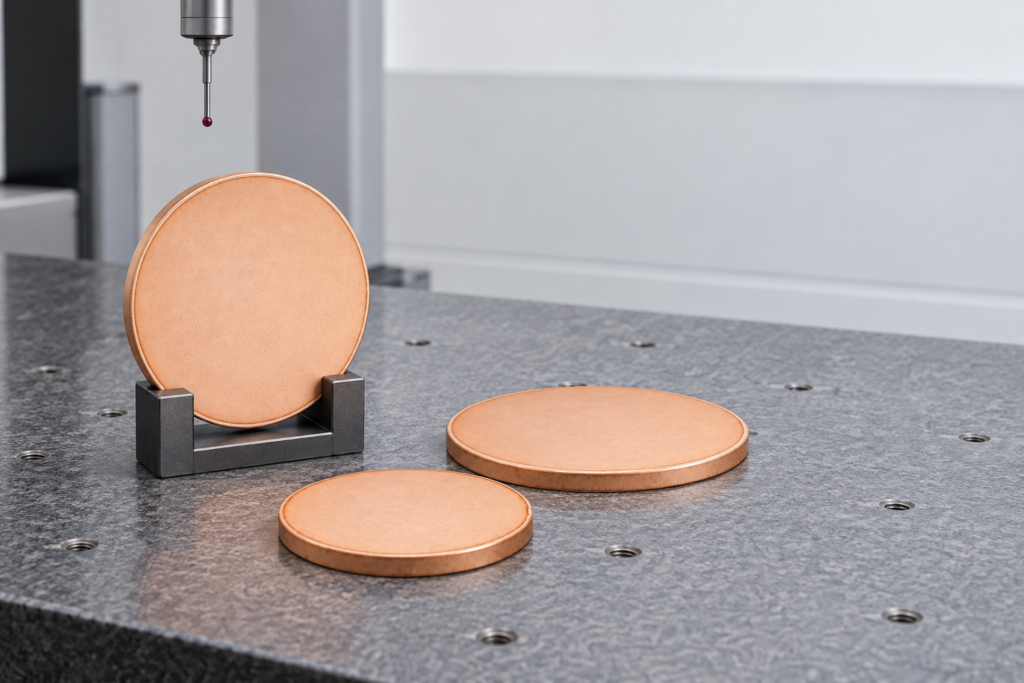
When a sourcing engineer in Suzhou encountered round blanks that warped during CNC facing, Mei Lin stopped the release and checked the mill certificate, temper and flatness map. Chatter, a hot face and scrap appeared. The reversal mattered: the material was not simply “bad”; the order lacked chemistry, stress, thickness tolerance and inspection evidence.
How does a round copper plate earn machining, electrical and thermal qualification?
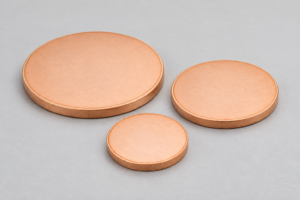
Start with the finished part. A Round copper plate flange may need stable temper and a flat datum; a copper plate contact may prioritize conductivity and face finish. Record diameter, thickness in millimetres, tolerance, edge, holes and allowance; state whether 4 mm is incoming or finished.
Join material identity to evidence: lot traceability, chemistry, hardness/temper, visual condition and dimensions. ASTM B152/B152M covers copper sheet, strip, plate and circles; specify ASTM E8/E8M for tensile properties. Retain the approved drawing, first-article report and change rule.
Conductivity is measured, not inferred from colour. Request resistivity/conductivity, method and temperature; ASTM B193 is used for conductor resistivity. % IACS is a comparable reference, with 100% IACS as the benchmark—not a promise that every temper behaves identically.
Thermal work adds contact resistance and heat path. Ask for high-conductivity copper, machinable temper or compatible coating as needed. ASTM E1461 addresses laser-flash thermal diffusivity; it is a test method, not a grade. The right copper plates carry a lot- and condition-linked report.
Clean faces and deburred edges improve contact and assembly. If plating, bonding or brazing follows, define preparation, oxidation allowance and storage before the copper plate ships.
How should buyers compare copper plates by risk and total cost?
Unit price rarely captures a failed interface or second setup. Cost tendency is directional because alloy, volume, finish, yield and freight change the quote.
| Option | Performance | Quality risk | TCO question |
|---|---|---|---|
| High-conductivity, soft temper | Electrical/thermal path | Check burrs, distortion, workholding | Will fixturing erase savings? |
| Higher-strength temper | Less clamping deformation | Verify tools and tensile/hardness data | Do fewer rejects justify premium? |
| Oxygen-controlled/special grade | Joining or atmosphere-sensitive duty | Require grade, chemistry, traceability | Is documentation tied to risk? |
| Finished/pre-machined blank | Shorter downstream cycle | Check datum, flatness, edge, method | Compare conversion, scrap and logistics. |
For repeat work, calculate illustrative total cost as material, conversion, inspection, packaging, freight and expected scrap; tie each line to an operation, tolerance or test.
Which dimensions and applications change the buying decision?
| Application | Dimensions | Qualification focus | Evidence |
|---|---|---|---|
| CNC flange/ring | Finished OD/ID, thickness, holes, datum | Flatness, temper, burr, allowance | First article, traceability |
| Electrical contact | Area, thickness, edge, joint | Conductivity, cleanliness, contact plan | Resistivity, surface record |
| Thermal spreader | Footprint, thickness, flatness, interface | Heat path, voids, corrosion compatibility | Thermal method, flatness map |
| Prototype/tooling | CAD profile, revision, quantity, tolerance | Fast feedback with material identity | Drawing approval, change log |
For many copper plates, standardizing two or three diameter-thickness combinations simplifies inspection and nesting. For unusual geometry, send drawing, duty cycle and mating materials; the supplier can recommend a cut blank or machined round copper plate.
Which standards and compliance records should a copper plate supplier provide?
Separate supplied material, test method and destination rule. ASTM B152/B152M defines covered copper forms; ASTM B193 defines resistivity; neither proves certification for every end use. Review destination equipment, safety and environmental rules.
Request grade, temper, dimensions, tolerances, lot/heat, inspection and packing records. Unsupported certificates or “meets all standards” claims can cause rejection and customs risk; records must match the actual copper plate, method and destination.
How should procurement teams select a round copper plate supplier?
- Issue a controlled drawing: grade, temper, diameter, thickness, tolerances, surface, edge, quantity and revision.
- Describe duty: machining, current/heat load, mating materials, joining and environment.
- Require a sample or first article with dimensional, visual and agreed property evidence.
- Compare total cost, lead time, packaging, traceability, change control and nonconformance response.
- Keep an approval record so substitutions are reviewed, not assumed equivalent.
DONGYAO is a configurable copper and aluminium conductor manufacturer; share drawing and duty data so the quote matches blank, finish and documentation. Review products after specification; a copper rod or copper busbar may suit another geometry.
Frequently Asked Questions
What is a copper plate worth?
There is no responsible single price: quotes depend on grade, temper, diameter, thickness, tolerance, finish, quantity, testing, packaging, freight and terms. Ask for a line-item B2B quote tied to a drawing and lot documentation, then compare total cost and rejection risk.
Does Home Depot sell copper plates?
Retail home-improvement stores may list copper sheet or hobby material, but alloy, thickness and certification vary. For a machined, electrical or thermal component, use an industrial supplier that confirms grade, dimensions, tests and traceability.
What are copper plates called?
They may be called copper circles, discs, blanks, cut pieces, contact plates or thermal spreaders. The name matters less than a controlled drawing, alloy, temper and finished dimensions; include the trade term and technical definition in the purchase order.
How much does a 4×8 sheet of copper cost?
A 4×8 sheet price changes with thickness, alloy, temper, finish, quantity, market movement and freight, so a universal retail figure misleads. If cut into copper plates, request a quote separating yield, cutting, inspection, packaging.
References
- CDA: Copper alloys, properties and uses
- CDA: Copper 101
- CDA: Standards and specifications
- CDA: Copper in architecture
- CDA: Busbar applications
For a drawing-led review of a Round copper plate, contact DONGYAO through the engineering enquiry team with application and dimensions.
For related conductor products, view the product categories.