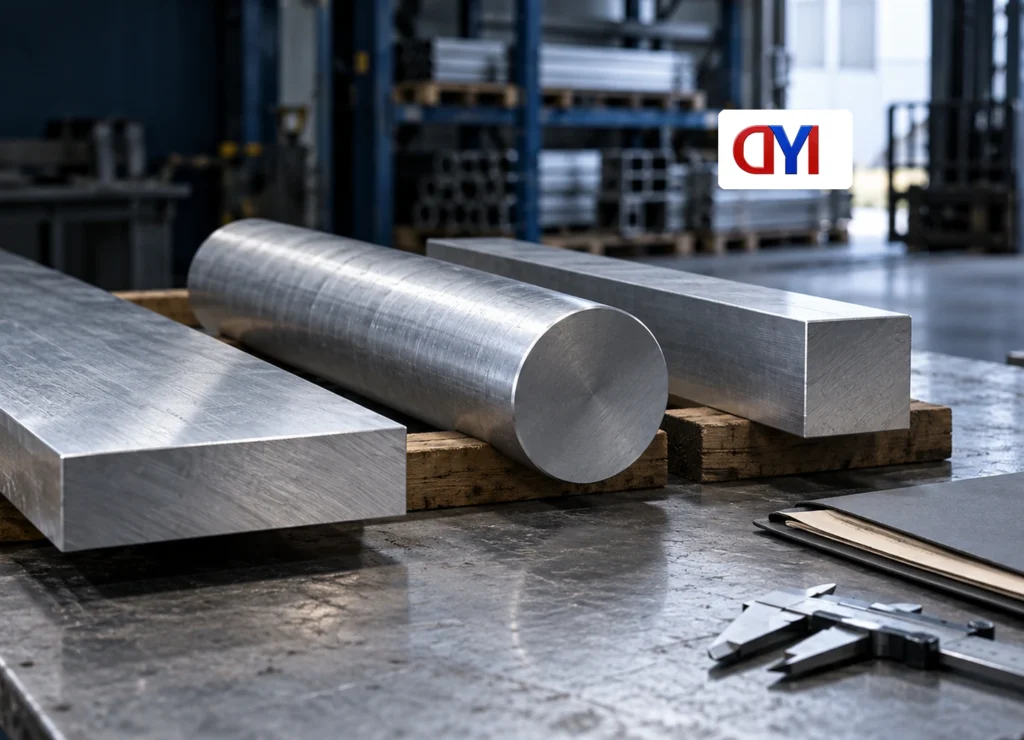
When a fabrication buyer in Birmingham, Maya, encountered cracked brackets after sending aluminum flat bars straight to a bending operation, the first suspect was the material supplier. In this illustrative scenario, the purchase order had omitted the temper. The corrective action was to specify the forming condition and bend requirements before ordering another batch.
Summary: Choose aluminum bars by alloy, temper, section and manufacturing route together. ASTM B221 covers extruded products; the 6061 or 6063 designation alone does not define their finished-part strength. Compare the requirements for fabrication and finish, then quote the cost per accepted component rather than only the price per kilogram.
6061 and 6063 answer different fabrication needs
6061 is a common choice for machined brackets, frames and general structural components. 6063 is frequently selected for extruded shapes and visible surfaces where finish matters. Neither is automatically the right choice for every aluminum flat bar. A load-bearing bracket needs a strength calculation; a decorative trim needs a different acceptance plan.
Aalco’s 6061-T6 extrusion datasheet identifies good formability in T4 but limited formability in T6. Its published mechanical values have dimensional and product-form limits. Do not copy a minimum proof stress from one datasheet into an order for a different section or temper. For 6063, consult the matching extrusion datasheet and the current purchase specification rather than assuming all 6xxx alloys share one strength value.
The temper is part of the material identity. T6 describes a heat-treatment condition, while an alloy number identifies a composition family. Welding or subsequent thermal processing may alter local properties. The drawing owner should approve the condition in which a formed or welded part is accepted.
| Buying priority | 6061 bar | 6063 bar | What to verify |
|---|---|---|---|
| Machined structural component | Common candidate | Evaluate against actual load | Minimum properties for the supplied form and size |
| Visible extruded profile | Check finish requirements | Common candidate | Surface sample and finish specification |
| Tight forming operation | Temper strongly affects suitability | Temper still matters | Trial bend, orientation and radius |
| Welded assembly | Consider local property changes | Consider local property changes | Joint procedure and final design basis |
Select the stock section around the finished part
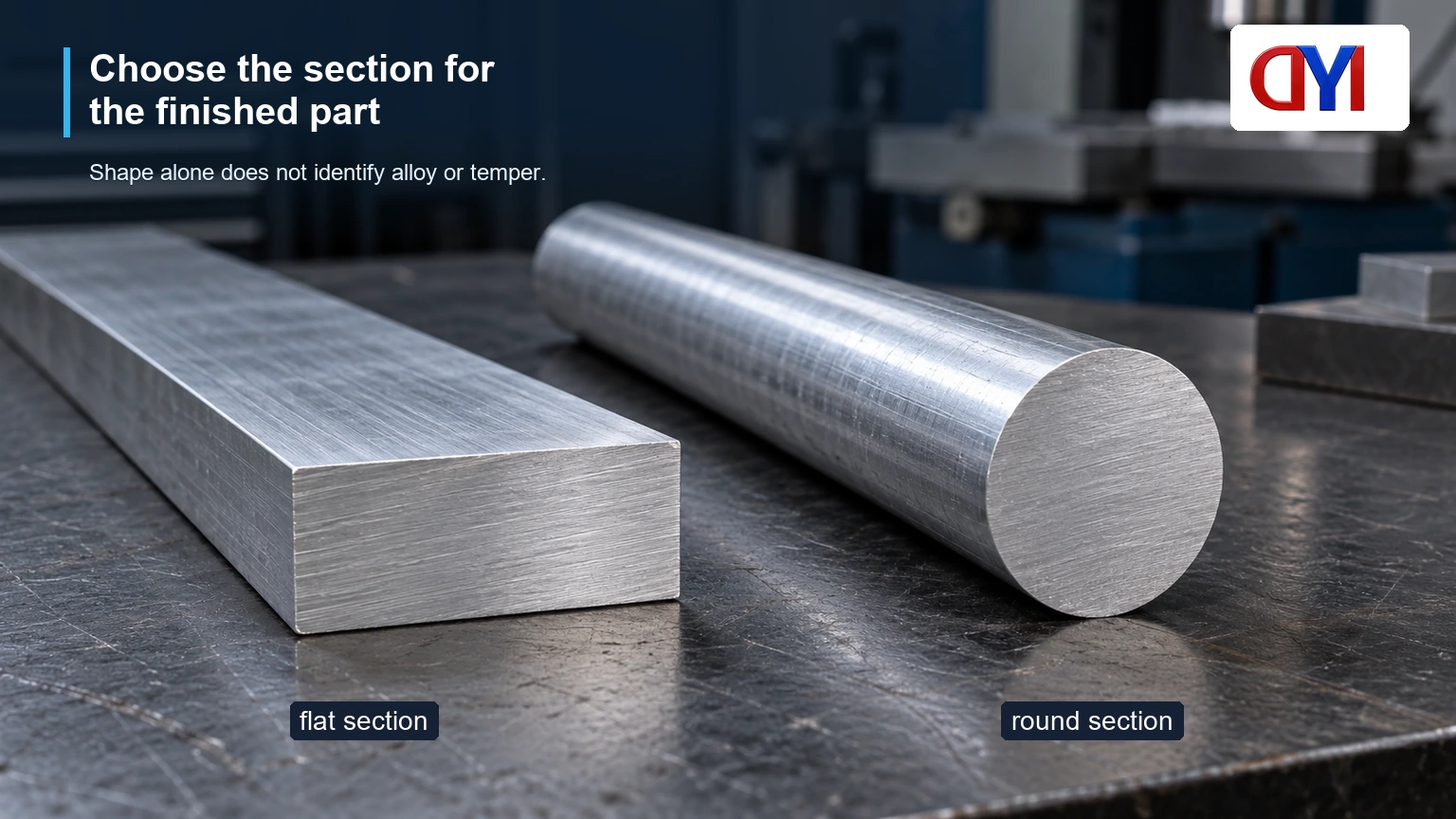
Flat, round and square stock create different machining envelopes. A round boss usually starts economically from round stock; a flat bracket may fit rectangular stock with less material removal. A square bar can suit a component with several machined faces, but only after allowing for the finished geometry and clamping method.
For a simple illustrative calculation, a 20 × 5 mm flat section has a nominal area of 100 mm². That calculation describes geometry only. It does not establish bending strength, allowable load or dimensional tolerance. ASTM B221 and the agreed drawing provide the product and ordering context; actual dimensions must be inspected.
Buyers planning a bend should also review the process issues discussed in bending aluminum flat bar. Confirm which faces remain visible, whether machining removes the original finish, and whether the part will be anodized after fabrication. A good-looking stock surface does not guarantee a uniform finished assembly.
Calculate cut-to-length yield before comparing prices
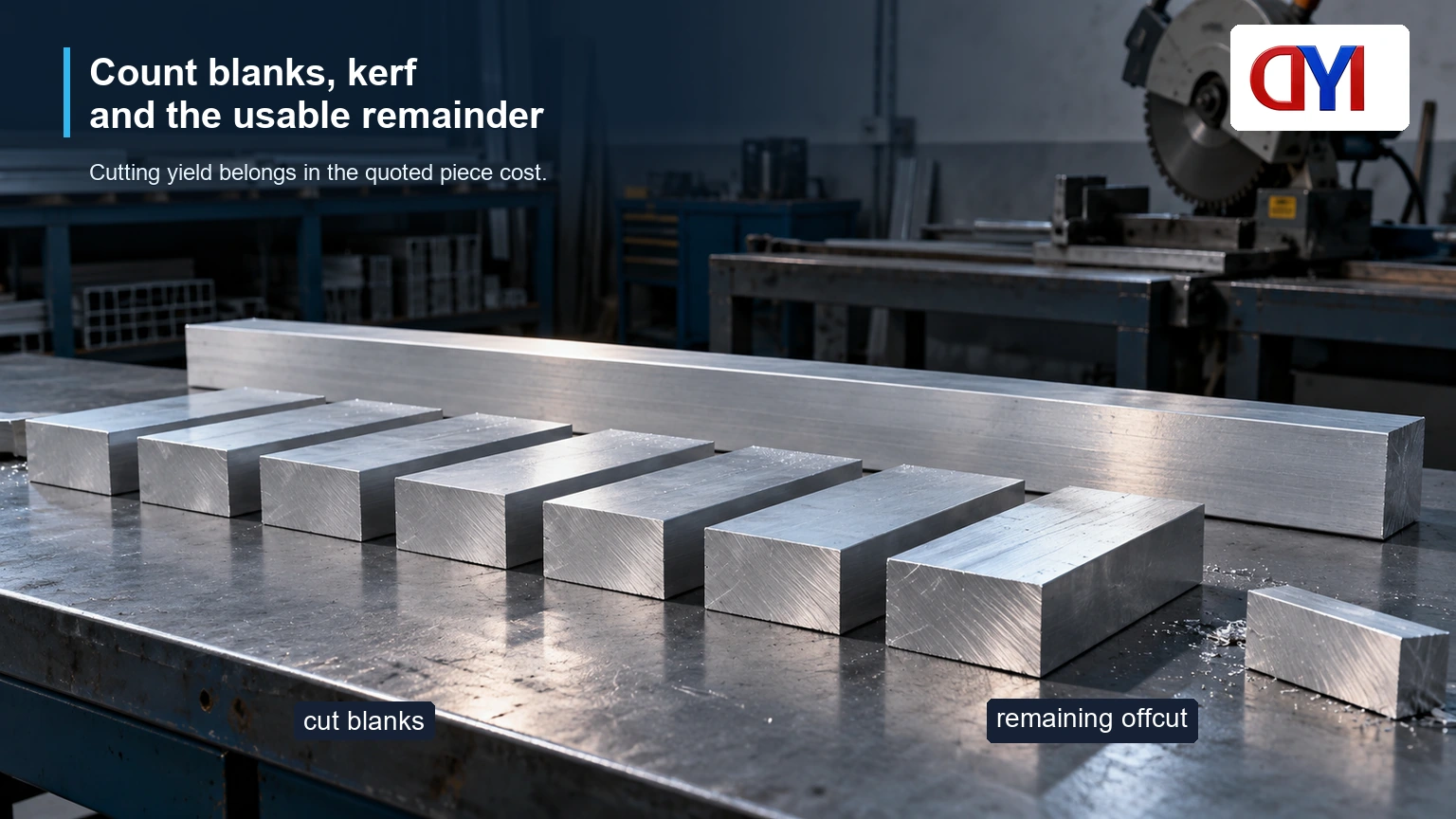
A long bar price is incomplete without the cutting plan. Include blade kerf, end trimming, damaged-end allowance, usable remnants, setup and inspection. State whether the supplier quotes gross purchased mass, delivered mass or finished pieces. These are different commercial bases.
Consider an illustrative 3,000 mm stock length, 500 mm blanks and a 3 mm saw kerf for each cutoff. Six blanks would require 3,018 mm before any end allowance, so six cannot be obtained under that plan. Five blanks use 2,515 mm and leave 485 mm before further trimming. The example is a planning calculation, not a production recommendation; an actual nesting plan may use a different cutting sequence.
| RFQ dimension | State explicitly | Cost or acceptance effect |
|---|---|---|
| Cross-section | Width and thickness, or diameter/across-flats | Material mass and machining allowance |
| Cut length | Nominal length and permitted deviation | Saw setup, inspection and usable yield |
| Straightness | Method, gauge length and permitted deviation | Clamping and machining stability |
| Ends and edges | Squareness, burr limit and edge condition | Safe handling and assembly fit |
| Finish | As supplied, machined or specified treatment | Rework and appearance acceptance |
Standards and acceptance records
ASTM B221 addresses extruded aluminum products; its scope distinguishes them from rolled or cold-finished bar covered by other specifications. Alloy and temper designations follow ANSI H35.1/H35.1M within that standard’s framework. Specify the agreed edition and the applicable product form on the order.
Supplier datasheets are useful screening documents, not substitutes for a batch inspection certificate. Request material identity, applicable mechanical requirements, dimensional results and traceability. An ASTM reference on an RFQ is a requirement to be met, not evidence that a supplier or batch is certified.
Build an RFQ that can be compared
- Identify the finished component, service conditions and governing drawing revision.
- Specify alloy, temper, stock form and dimensions together.
- Define cutting, forming, finish and acceptance requirements before requesting prices.
- Compare delivered usable pieces, including setup, inspection, packaging and waste.
DONGYAO’s materials and processing catalog provides a starting point for a sourcing discussion. Ask for written confirmation of the specific aluminum alloy, temper and stock form available for your project; a broad materials catalog does not establish availability of every combination.
Frequently asked questions
What are aluminum flat bars used for?
They are used for brackets, spacers, frames, supports and machined components. The application must match the alloy, temper and section properties. Electrical conductor service requires additional electrical and connection requirements.
Is aluminum flat bar strong?
It can provide useful structural strength at low mass, but strength is not defined by the word aluminum. The alloy, temper, section orientation, span and loading determine suitability. Use the finished-part design calculation.
How much does a bar of aluminum cost?
Price depends on alloy, temper, dimensions, quantity, cutting and finish. Request a dated quote with its mass or piece basis. Include usable yield and processing costs when comparing offers.
Where can I find aluminium bars for sale?
Use a stockholder or processor that can document the required material and provide the ordered section. Confirm whether the quote is for existing stock or a production run. Obtain the actual lead time and inspection package in writing.
How do alloy and temper affect aluminum bar selection?
Alloy affects the available balance of strength, corrosion behavior and fabrication characteristics. Temper changes mechanical condition and forming response. Specify both, then verify properties for the exact supplied form and dimensions.
What dimensions are needed when ordering cut-to-length aluminum bar stock?
Provide width and thickness for flat stock, diameter for round stock, or across-flats dimensions for square stock. Add cut length, tolerances, straightness, end squareness and edge requirements. Include the quantity and drawing revision.
References
- ASTM B221: aluminum-alloy extruded bars, rods and profiles
- Aalco: 6061-T6 extrusion datasheet
- Aalco: 6063-T6 extrusion datasheet
The economical bar is the one that reaches the finished drawing with predictable yield. Send the material condition, cutting plan and quantities to DONGYAO’s contact team for a documented sourcing review.
For related conductor products, view the product categories.