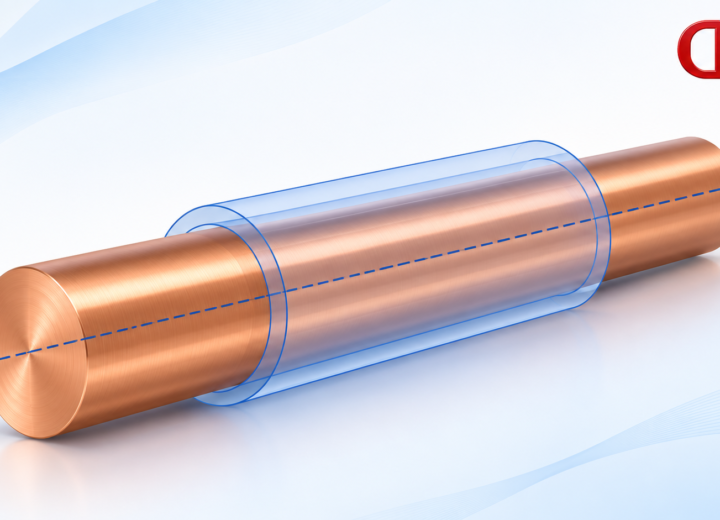
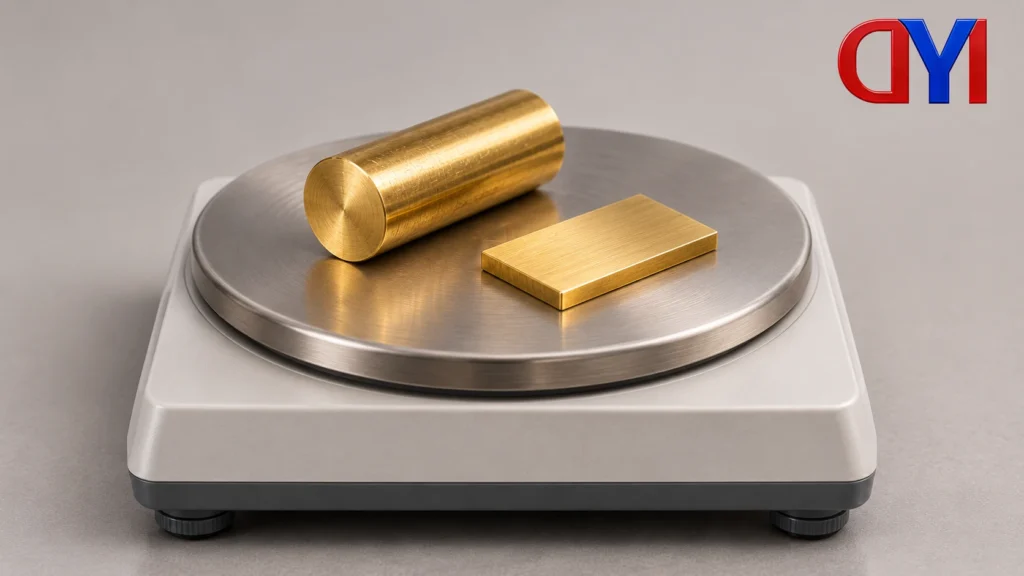
The density of brass material is grade-specific. As one published example, C26000 brass is listed at 8.5 g/cm³ at 20°C, equivalent to 8500 kg/m³. Use that as a labelled reference example, not as a certified value for every brass rod, plate or finished component.
To estimate a part’s mass, you also need its net metal volume. Selecting a plausible density while using the wrong volume or mixing units can make an otherwise simple calculation misleading.
Why the density of brass material needs a grade
Brass is a copper-zinc alloy family. Its composition varies, and additional alloying elements may be present in particular grades. Kupferverband’s discussion of copper-zinc alloys explains that density changes with zinc content in the alloys it describes.
That is why a material-property table lists individual grades rather than assigning one precise constant to all brass. Before copying a value, identify the alloy designation, the source units and any stated reference temperature.
The C26000 example above comes from a material producer’s reference page. It is useful for illustrating the lookup process, but its other product specifications and manufacturing claims do not become specifications for another supplier’s material.
Appearance does not close that evidence gap. Alloy additions can change brass color, so a golden surface is not a grade certificate. Preserve the material designation and documentation when density matters to a calculation or purchasing decision.
Use consistent units for a mass estimate
For a simple homogeneous part, estimated mass equals density multiplied by net material volume:
m = ρ × V, where m is mass, ρ is density and V is net metal volume.
If density is in g/cm³, use volume in cm³ to obtain grams. If density is in kg/m³, use volume in m³ to obtain kilograms. The two systems describe the same relationship, but their numerical values cannot be mixed without conversion.
For a fictional example, suppose the finished part has a net volume of 20 cm³. Using the reference density of 8.5 g/cm³ gives:
8.5 g/cm³ × 20 cm³ = 170 g.
This is an arithmetic estimate, not a measured part mass or an acceptance tolerance. It assumes the selected density applies to the material and that the stated volume represents the remaining homogeneous metal.
Calculate the remaining metal, not just the outside envelope
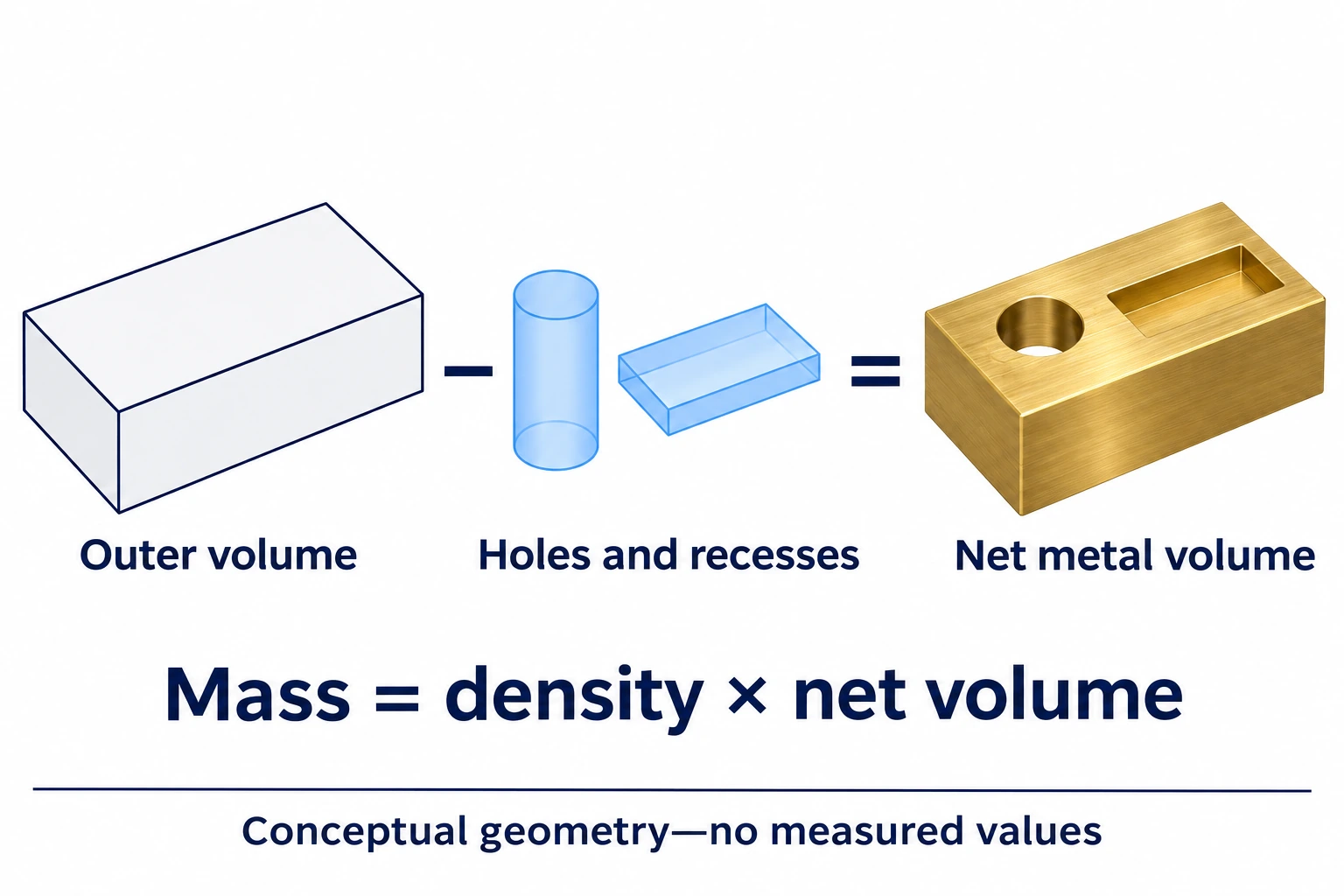
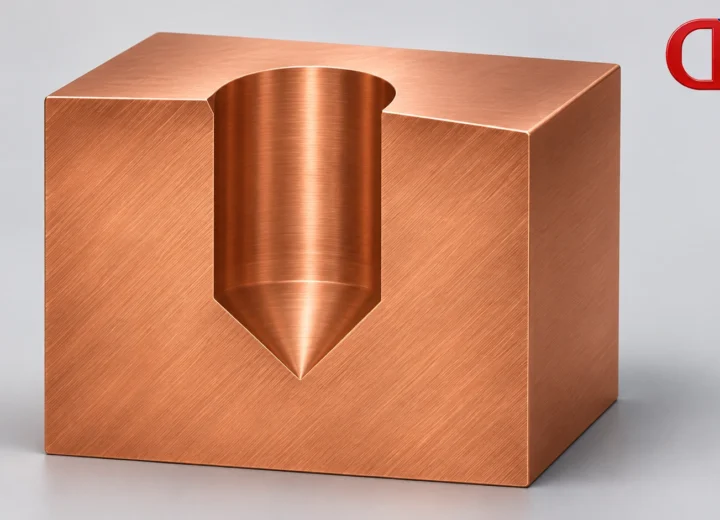
A drilled or recessed block contains less metal than a solid block with the same outside dimensions. Use the finished geometry when estimating finished-part mass. Using the original stock envelope instead answers a different question about the blank.
For a more complex part, identify what the volume calculation includes. Coatings, inserts and assembled hardware should not silently be treated as the same brass material. Keep a finished-part estimate separate from packaged shipment mass as well.
Worked example: dimensions in millimeters
Take a fictional rectangular blank measuring 50 × 20 × 20 mm. Its envelope volume is 20,000 mm³. Because 1 cm³ equals 1,000 mm³, that is 20 cm³. The reference-density calculation for a solid blank is therefore the same 170 g estimate shown above.
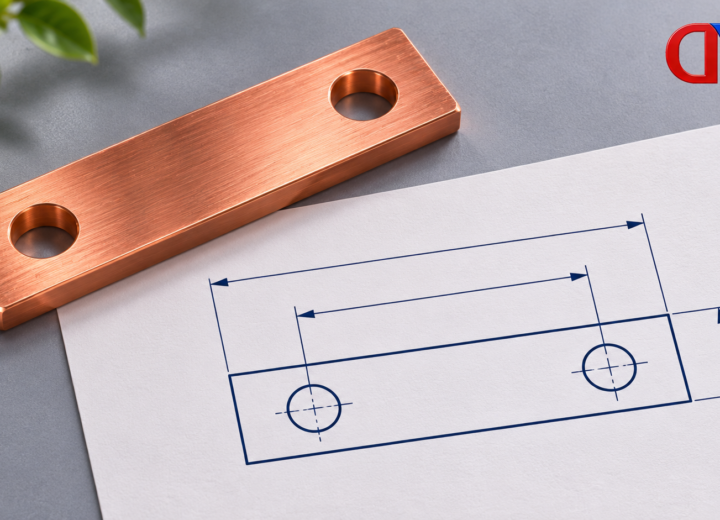
Now add one ideal cylindrical through hole, 5 mm in diameter and 20 mm long. Its radius is 2.5 mm. The removed volume is π × 2.5² × 20, approximately 392.7 mm³ or 0.3927 cm³. Assume no other removed features and ignore edge breaks in this simplified model.
The remaining volume is approximately 20 − 0.3927 = 19.6073 cm³. Multiplying by the same reference density gives 19.6073 × 8.5 ≈ 166.7 g. The hole changes the estimated mass by about 3.3 g. These rounded results describe the stated ideal geometry; they are not a weighing result or a promised mass tolerance.
Notice where the conversions occurred: all geometric dimensions entered the calculation in millimeters, then the volume was converted before multiplying by g/cm³. A millimeter-to-centimeter length conversion is a factor of ten; a cubic-volume conversion uses that factor in all three dimensions.
Choose the mass question before choosing the model
A material-planning estimate for the starting blank and a finished-part estimate can both be correct while giving different values. The blank calculation retains material that machining will remove. The finished-part calculation uses the remaining geometry. Label the result so the reader knows which object the number describes.
For an assembly, account for the separate components rather than applying brass density to the complete external shape. Where the material itself is uncertain, resolve that before refining the geometry. The copper, brass and bronze comparison explains why related copper-based family names do not establish one grade. More decimal places in the volume do not repair an unsupported material assumption.
Keep density separate from material acceptance
A mass estimate helps with material planning and comparison, but it does not supply the missing evidence for grade, mechanical properties or suitability for the intended service. Match each requirement to the relevant material record or agreed inspection evidence.
When comparing two density sources, check whether they describe the same grade and temperature, and whether their units and rounding match. Reference tables can be useful without being design data; thyssenkrupp Materials NA explicitly states that limitation on its physical-property table.
For a rod inquiry, DONGYAO’s brass rod product is a relevant starting point. Specify the required grade, stock form and drawing, then confirm the applicable material data. The product identity alone does not establish C26000 equivalence or a certified density.
References
- bedra: C26000 brass reference data
- Kupferverband: Copper-zinc alloy properties
- thyssenkrupp Materials NA: Alloy physical properties
For related conductor products, view the product categories.