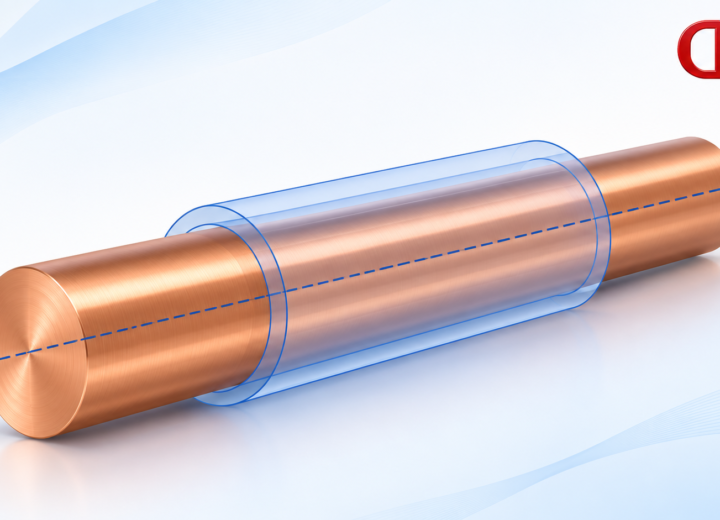
Copper and copper alloys should be specified by an exact material designation, not only by color or a general purity claim. For the grades discussed here, C110 refers to UNS C11000 electrolytic tough pitch copper. C10100/Cu-OFE and C10200/Cu-OF are distinct oxygen-free copper descriptions; they should not be collapsed into one unspecified material.
Copper and copper alloys: family is not grade
A family name provides broad compositional context. The International Copper Association describes brass as a family of copper-zinc alloys with differing combinations of properties. Other copper alloy families serve different material requirements. “Copper alloy” therefore leaves the actual material selection unresolved.
A grade designation narrows that discussion. The buyer still needs to identify the designation system and the required product. A familiar short name on an inquiry should be expanded before anyone treats it as an agreed material specification.
This matters when reading a supplier catalog. A material-family overview, a named grade and a certificate for a delivered lot answer different questions. A general description can help shortlist materials; it cannot establish that a particular supplied rod or plate meets the purchase requirement.
C11000, C10100 and C10200 in source context
Aurubis’s published Shapes material table separates oxygen-bearing copper from oxygen-free copper. Its examples identify the following combinations. This is a concise reading aid for those source entries, rather than a complete grade specification.
| Full designation in the source | Description | Distinction to retain |
|---|---|---|
| C11000 / Cu-ETP | Electrolytic tough pitch copper | Listed in the oxygen-bearing group |
| C10100 / Cu-OFE | Oxygen-free copper example | A distinct designation from C10200 |
| C10200 / Cu-OF | Oxygen-free copper example | Keep the full grade in the inquiry |
“Oxygen-free” should be read through the applicable composition limits. For example, Aurubis lists oxygen at no more than 0.0003% for its OF01/C10100 entry. That is a stated trace limit, not proof of literally zero oxygen atoms. The value describes that manufacturer’s published entry, not a test result for a DONGYAO product.
Purity also needs its stated basis. IMI’s wire-rod descriptions give minimum copper contents of 99.99% for Cu-OFE and 99.95% for Cu-OF. These supplier examples explain why a generic oxygen-free label does not replace the full designation. They are not certificates for another supplier’s delivery.
The purity number is consequently one item to compare with the purchase specification. It does not, by itself, answer every required mechanical, processing or electrical-property question. Those requirements should remain explicit rather than being inferred from the highest percentage.
Read the label beside a material number
A composition number changes meaning when its qualifier changes. The IMI examples above are minimum copper contents; the Aurubis oxygen example is a maximum limit. Neither is presented here as a measured value from a delivered lot. Keep the minimum or maximum label attached when transferring a value into a comparison.
A nominal description serves a different purpose from a measured result. In a material discussion, ask whether a number identifies a general product description, a specified limit or a reported lot result. Then identify which document supplied it and which material designation that document covers. A number without that context can look precise while answering the wrong question.
For example, the maximum oxygen entry does not mean every supplied piece contains exactly that amount. Likewise, a minimum copper statement should not be rewritten as an exact measured composition. The appropriate delivery evidence must relate to the actual requirement and the material offered.
Carry the designation into the material request
A practical material review can separate four inputs: grade, product form, condition and material evidence. The following framework is an editorial aid for organizing an inquiry, rather than a certificate or an equivalence table.
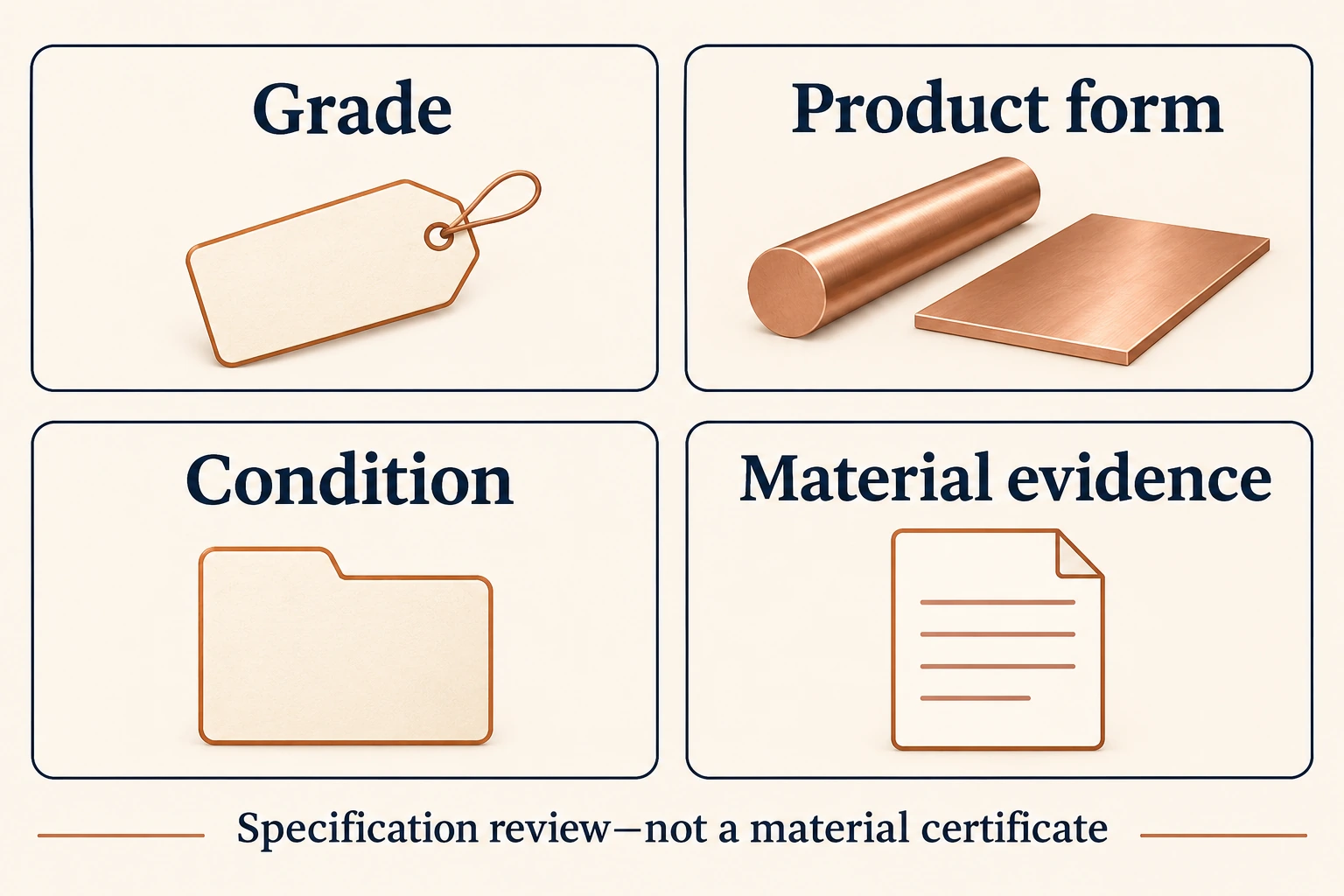
Begin with the complete grade and its required specification system. Then identify the form being purchased and the required condition. If a proposed alternative uses another naming system, ask for the relevant specification comparison rather than accepting a short-name substitution.
Next, state the properties and documentary evidence the order requires. Ask what material information the supplier can provide for the proposed delivery. A general catalog percentage should not silently stand in for the evidence requested by the buyer.
For a pure copper rod inquiry, confirm the actual offered grade and documents. The product category alone establishes neither C11000/C10100/C10200 availability nor equivalence with another national designation. Agreement on the full material requirement makes the subsequent comparison meaningful.
Compare a full-grade request with a generic offer
Suppose a fictional inquiry calls for C10100 rod in a defined condition, while the response says only “oxygen-free copper, high purity.” The response has supplied a family description and a general quality phrase, but it has not yet answered the full-grade request. Ask for the offered designation, product form, condition and applicable material evidence before treating the two descriptions as aligned.
If another naming system appears in the response, compare the relevant specifications and requirements. Similar color, a short trade name or a purity percentage is not enough to establish cross-standard equivalence. The copper-family comparison explains the broader distinction between a family and a grade.
A quick workshop observation has the same limitation. The magnetism and material-screening guide explains why a magnet observation cannot certify a copper grade. Use that kind of observation to describe what happened, while the purchase comparison remains tied to the full designation and required records.
References
- International Copper Association — Copper Attributes and Alloys, alloy-family context.
- Aurubis — Copper in Top Shape, published grade entries.
- IMI — Copper Wire Rod, ETP, OFE and OF descriptions.
For related conductor products, view the product categories.